Quick answer: Roblox's age verification is generally safe for your child's privacy. The face scan is processed by a certified vendor called Persona and deleted right after. Roblox says it never receives or stores biometric data. Since January 2026, every user must pass this age check before chatting. The scan sorts users into six age groups that limit who can talk to whom. It raises the bar, but it is not precise and can be tricked, so staying involved still matters.
If your child plays Roblox, they have almost certainly hit a new screen asking them to scan their face before they can chat. This is the biggest safety change Roblox has made in years, and it landed fast: a phased rollout that started in Australia, New Zealand, and the Netherlands in December 2025 went global in January 2026.
The headlines make it sound like the problem is solved. It is not. Age verification raises the bar, but it comes with real accuracy gaps, privacy trade-offs, and workarounds. This explainer walks through exactly how the system works, what changed and when, and what it means for your family in plain terms.
Key takeaways for parents
Chat now requires an age check. No verification, no voice or text chat. Playing games without chat still works.
The default method is a face scan. The camera takes a short selfie-style video and estimates age. Government ID is an option for 13 and up, and parents can verify a child through parental controls.
Roblox says nothing is stored. The video is deleted after processing, handled by its vendor Persona.
Users are sorted into six age groups. The system tries to keep under-16s from chatting with adults by default.
It is not exact. The age estimate is off by about 1.4 years on average, and people have tricked it with simple disguises.
It is a layer, not a fix. Grooming still moves to other apps, and account ages can be faked. Keep talking and stay involved.
What changed, and when
For years, Roblox let children self-report their age by typing a birthday. That was easy to fake and did little to keep adults out of children's conversations. In November 2025, Roblox announced it would gate communication features behind an actual age check.
The rollout was staged. It began in Australia, New Zealand, and the Netherlands in early December 2025, then expanded worldwide in January 2026, starting in the US and reaching all regions where chat is available within about a week. Roblox described it as the first large gaming platform to require age checks for chat across all ages. By August 2026, the system had processed more than 338 million age-check records.
The change applies to every user who wants to talk to others. You do not have to verify to play games, but you do to use chat. By the time of the global announcement, Roblox said more than half of daily active users in the first three countries had already completed the check, and tens of millions had verified worldwide.
Some context on why this arrived when it did: Roblox filed 65,381 CyberTipline reports with the National Center for Missing and Exploited Children in 2025, up from 24,522 the year before and just 2,973 in 2022. The platform also faces lawsuits from several US states, including a March 2026 suit from Nebraska's attorney general alleging Roblox exposed children to predators while marketing itself as safe. Roblox disputes those characterizations. The age check is part of how the company is responding to that pressure.
What does Roblox age verification require for chat?
Every Roblox user who wants to send or receive any kind of message, text chat, voice chat, or direct messages, must first complete an age check. Playing games without chat still works with no verification.
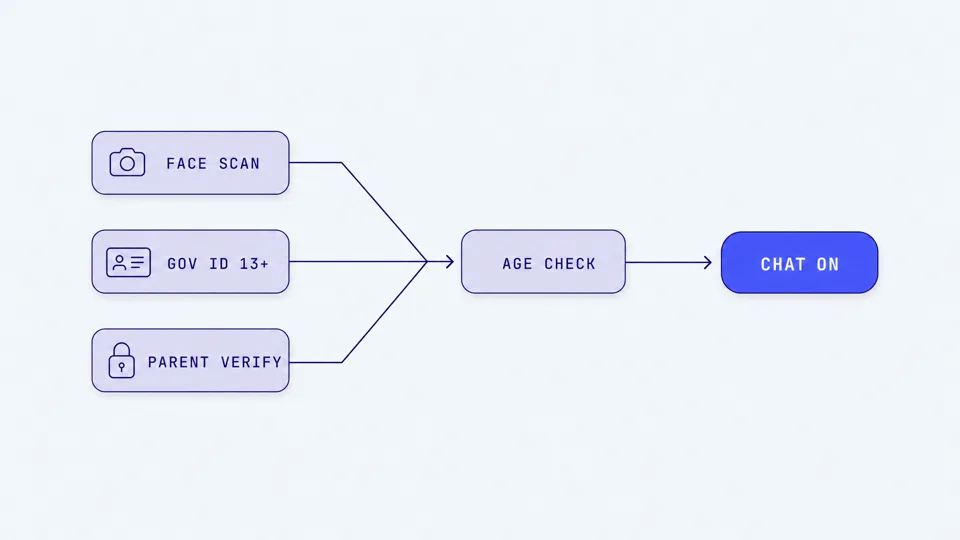
There are three ways to complete the check:
Facial age estimation (the default). The app uses the device camera to take a short selfie-style video and estimates the user's age. This takes a few seconds.
Government ID. Available to users 13 and older. A valid ID is scanned and verified against a selfie.
Parental controls. A parent verifies the child's age directly, which avoids the face scan entirely. This is the route we recommend for younger children.
Since June 2026, Roblox also assigns children to account types based on age: Roblox Kids (ages 5 to 8) and Select (ages 9 to 15). Kids accounts have all communication disabled by default. Select accounts keep the standard chat defaults for that age group. Both limit the game catalog to age-appropriate titles. For more on what the chat filter blocks and what passes through, see our guide to Roblox's chat filter.
How the Roblox face scan works
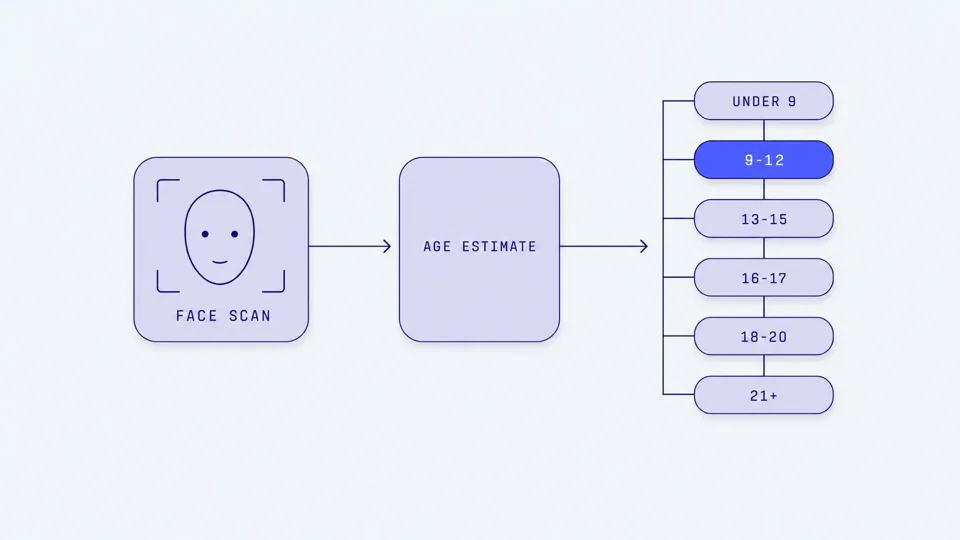
Most users complete the age check with facial age estimation. The Roblox app uses the device's front camera to capture a short selfie-style video. That video is sent to Persona, a third-party identity vendor, which uses AI to estimate the person's age from their face. The whole thing takes seconds.
Roblox states that the images and video are deleted immediately after processing, and that Roblox itself does not receive or store the raw video or any biometric data. In other words, the face data lives briefly with the vendor to produce an age estimate, then is discarded, according to Roblox.
There are two other paths. Users 13 and older can verify with a government-issued ID instead of a face scan. And parents can verify a child's age directly through parental controls, which is the route to use for younger children who should not be scanning their own faces or who fail the estimate.
What happens to the selfie after Roblox age verification?
The short selfie video is sent to Persona, an identity verification company that processes the data on Roblox's behalf. Persona's AI estimates the user's age from the video and returns only the age estimate to Roblox.
According to Roblox, the images and video are "deleted immediately after they've been securely processed." Roblox states it does not receive or store the raw video or any biometric data from the facial age estimation. The company also says Persona "does not sell an individual's data or permit access to third parties." Persona holds ISO/IEC 30107-3 certification for presentation-attack detection, and its facial age estimation met Level 3 (Highly Effective) of the UK Age Check Certification Scheme's technical requirements.
One thing to weigh: Roblox's own privacy notice says Persona deletes biometric data within 30 days unless the law requires longer. That is different from the "immediately deleted" framing in Roblox's public messaging. For most families the practical risk is low, but if the gap between those two statements bothers you, the parental-controls path lets you verify your child's age without a face scan at all.
Roblox age verification groups and who can chat
Once the check is done, Roblox places each user into one of six age groups: under 9, 9 to 12, 13 to 15, 16 to 17, 18 to 20, and 21 and up. Your child's estimated or verified age determines their band, and the band determines who they can talk to.
The core rule is simple. By default, a user can chat with people in their own group and in the groups directly above and below. So a 9-to-12 user can talk to other 9-to-12s, plus the under-9 group and the 13-to-15 group. The intended effect is that users under 16 cannot chat with adults by default. There are two important exceptions to know:
Under 9: chat is off entirely unless a parent provides consent after an age check. This is the strongest default protection on the platform. If you are weighing whether to turn it on at all, we suggest leaving it off for children in this age group.
Trusted Connections: users who are 13 or older and age-checked can designate people they know as Trusted Connections and chat with them more freely, even across non-adjacent age groups. If your teen mentions adding a Trusted Connection, make sure it is genuinely someone they know in real life.
This is a meaningful structural change. Before, a 30-year-old and a 10-year-old could land in the same public chat with nothing between them. Now, by default, they cannot. For a deeper walkthrough of the specific chat and voice settings, see our Roblox voice chat safety guide.
Is the Roblox age verification safe?
For most families, yes. The face scan is processed by Persona, a certified third-party vendor, and deleted after processing. Roblox says no biometric data reaches its own servers. The risk here is about principle more than immediate danger.
Making tens of millions of children scan their faces is not a small thing, and reasonable parents land in different places on it. Roblox's position is that the scan is fast, is processed by a certified vendor, and leaves nothing behind: the video is deleted after processing and Roblox does not store biometric data.
The counterpoint, raised by privacy advocates, is that any face-scan system normalizes biometric collection for children and depends on you trusting a third party's deletion practices. Both things can be true. If you are uncomfortable with your child scanning their face, the parental-controls verification path lets you confirm their age instead, and you can simply leave chat disabled, which needs no scan at all.
Where the system falls short
Age verification is a real improvement, but it is not the wall it sounds like. Three gaps matter most.
It is not very accurate
Roblox cites a mean absolute error of about 1.4 years for under-18 users, based on testing by the UK's Age Check Certification Scheme. That number sounds small, but it means the estimate is routinely off by a year or more in either direction. Sitting right on a boundary is where it bites: a baby-faced 14-year-old can get pushed into the 9-to-12 band, and a mature-looking 12-year-old can land in 13-to-15 and unlock chat they should not have.
After launch, coverage from outlets including GameSpot and Engadget documented ages being wildly miscalculated. Reported examples included a 23-year-old placed in the 16-to-17 band and an 18-year-old dropped into the 13-to-15 band. An estimate is not an ID, even when it behaves like one.
It can be tricked
Within days of rollout, users were sharing how easily they got past the scan. Reported tricks included fake facial hair, drawn-on wrinkles or stubble, and in some cases holding up photos of adults or celebrities. None of this is difficult for a determined child, and none of this is difficult for a determined adult who wants into a younger age group.
The older workarounds still exist too. A child who typed a fake birth year years ago may already be treated as older. A younger sibling can use an account an older sibling already verified. Shared devices blur the lines further. The face scan closes one door, not all of them.
The risk often lives off Roblox
Even a perfect age check cannot follow a conversation once it leaves the platform. The documented grooming pattern is to build trust inside a children's game, then push to move somewhere with fewer controls: "add me on Discord," "let's talk on Snap." Age groups do nothing there. State attorneys general who have sued Roblox describe the same pattern, with predators meeting children in-game and moving the abuse to other apps. If you want the specific behaviors to watch for, read our guide to grooming warning signs in gaming.
How this fits with everything else you can do
Age verification changes who can reach your child. It does not tell you what is actually being said, and it does not extend past Roblox. Here is honestly where the different layers sit.
Layer | What it does | What it misses |
|---|---|---|
Roblox age verification | Gates chat, sorts users into age groups, keeps under-16s from adults by default | Not precise, can be tricked, does nothing off-platform |
Roblox parental controls plus PIN | Lets you disable or restrict voice and text chat, lock settings | Blocking only, no view of what is said |
Screen-time tools (Screen Time, Family Link) | Limit how long they play | Nothing about who talks to them or what is said |
Halo | Monitors voice chat and in-game text chat in every game on iPhone, iPad, Mac and Windows. Alerts you to grooming, bullying, or self-harm cues. | No Android yet. iOS needs a manual session start. |
These layers are not competitors; the strongest setup uses all of them. Verification on, chat locked to friends or off, and a way to be alerted if something genuinely dangerous is said. Halo monitors the voice chat and the in-game text chat in every game your child plays. It sends you an alert and a short summary when it detects grooming, bullying, or self-harm cues. Your child's voice never leaves their device. Only the words are analyzed, then discarded. Never stored. Halo runs on iPhone, iPad, Mac and Windows, with a 7-day free trial. No Android yet, and iOS needs a manual session start. It is the layer that can flag when something genuinely dangerous is said, which no age check can do. For the full picture across platforms, start with our voice chat safety guide.
For a verdict on whether Roblox is safe at each age from 5 to 13 under these new accounts, see our complete Roblox safety guide by age.
What to do tonight, by age
Under 9
Do not have your child scan their own face. Use parental-controls verification to set their age, and leave chat off (the default for this group).
Play in the same room when you can. The biggest risk at this age is another child showing them how to get around the checks.
Ages 9 to 12
Verify through parental controls if possible. Confirm chat is friends only or off, never Everyone.
Check the friends list and ask, "who is this, do you know them from school?" The main threat here is text-based luring, not voice.
Ages 13 and up
If they verify by face scan, sit with them once so you understand what group they landed in and whether it looks right.
Set voice and text chat to friends only, and talk about Trusted Connections: only real-life people, no exceptions.
What to say to your child
"Roblox now checks your age before you can chat. It's a good thing, but it's not perfect, so I still want us to keep talking about who you're playing with."
"If someone asks you to move the conversation to Discord or Snapchat, that's a red flag no matter how nice they seem. Tell me and you won't be in trouble."
"A Trusted Connection should only ever be someone you actually know in real life. If someone you met in a game asks to be one, say no and tell me."
"Some people lie to the age scan to seem younger. If anyone in a game feels off or too grown-up, trust that feeling and step away."
Frequently asked questions
What is Roblox age verification for chat?
Since January 2026, every Roblox user must pass an age check before they can send or receive messages. Most complete it with a facial age scan through the device camera, processed by a vendor called Persona. Users 13 and older can verify with a government ID instead, and parents can verify a child's age through parental controls.
Is the Roblox age verification safe?
The face scan itself is low-risk for most families. Roblox's vendor, Persona, processes the selfie video and deletes it immediately after estimating the user's age. Roblox says it does not receive or store biometric data. The trade-off is that any face-scan system normalizes biometric collection for children, and you are trusting a third party's deletion practices.
What happens to the selfie in Roblox age verification?
The short selfie video is sent to Persona, Roblox's identity vendor. Persona's AI estimates the user's age from the video, then the images and video are deleted immediately after processing, according to Roblox. Roblox states it does not receive or store the raw video or any biometric data. Only the age estimate is returned.
What are the Roblox age verification groups?
After the age check, users are placed in one of six bands: under 9, 9 to 12, 13 to 15, 16 to 17, 18 to 20, and 21 and up. By default, users can chat with their own group and the groups directly above and below. Under-9s have chat off unless a parent consents, and users 13 and up can add Trusted Connections for broader chat.
How accurate is Roblox facial age estimation?
Roblox cites a mean absolute error of about 1.4 years for under-18 users, based on UK certification testing. That means the estimate is often off by a year or more in either direction. In practice, users have reported adults being sorted into teen groups and, in some cases, minors being placed in older groups, so it is not precise enough to rely on alone.
Can the Roblox age check be tricked?
Yes, to a degree. After launch, users reported passing the scan with disguises like fake facial hair or drawn-on wrinkles, and some claimed success using photos of adults. Children can also still enter a fake birthday or use an older sibling's verified account. That is exactly why the age check should be treated as one layer, not a guarantee.
Does age verification stop predators on Roblox?
It helps but does not stop them. The age-group system keeps under-16s from chatting with adults by default, which raises the bar. But it relies on accurate verification, it can be circumvented, and grooming often moves to other apps like Discord or Snapchat where these rules do not apply. Staying involved and keeping the conversation open still matter.
Sources
[Roblox] "A New Era of Safety: Facial Age Checks Now Required to Chat on Roblox." January 2026. about.roblox.com
[Roblox] "Roblox Requires Age Checks for Communication, Ushering in New Safety Standard." November 2025. about.roblox.com
[Roblox] "Beyond the Selfie: How Roblox's Age-Assurance System Helps Keep Age Checks Current." August 2026. about.roblox.com
[Roblox] "Introducing Roblox Kids and Select Accounts." April 2026. about.roblox.com
[Roblox] "Facial Age Estimation for Safer Chat." about.roblox.com/age-estimation
[Roblox Support] "Understanding Age Checks on Roblox" and "How to chat on Roblox." en.help.roblox.com
[Roblox Support] "Roblox Biometric and Facial Media Data Privacy Notice." en.help.roblox.com
[TechCrunch] "Roblox now requires all users globally to complete age checks to access chat." January 2026. techcrunch.com
[GameSpot] "Roblox Has Added Facial Age Verification, With Very Mixed Results." 2026. gamespot.com
[Engadget] "Roblox now requires age verification to use in-game chat." 2026. engadget.com
[NCMEC] "CyberTipline Reports by Electronic Service Providers." 2022, 2023, 2024, 2025 annual reports. missingkids.org
[Nebraska Attorney General] "Hilgers Files Lawsuit Against Roblox for Enabling Child Exploitation." March 2026. ago.nebraska.gov
This explainer is updated as Roblox changes its verification and safety features. Last reviewed September 2026.