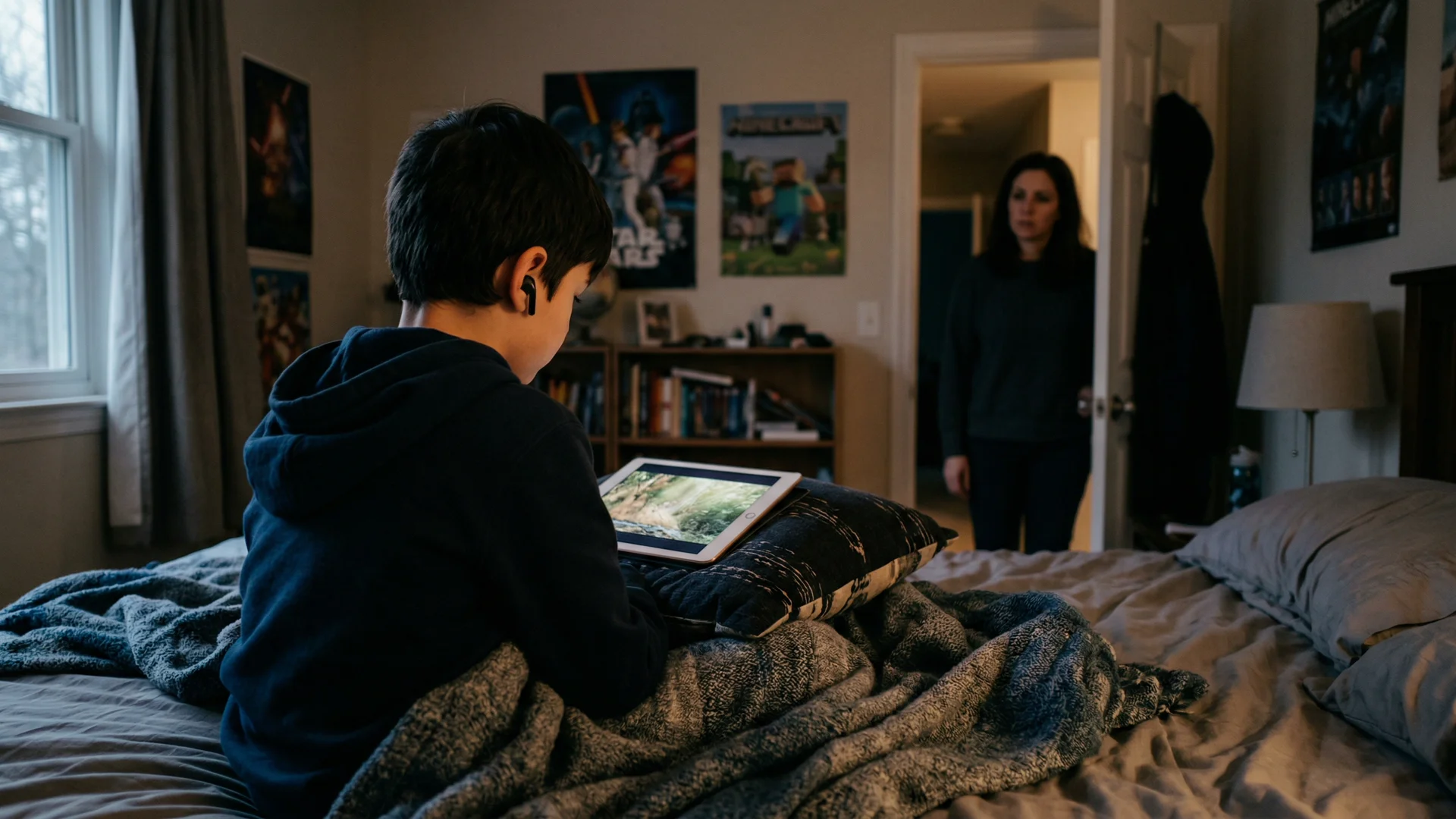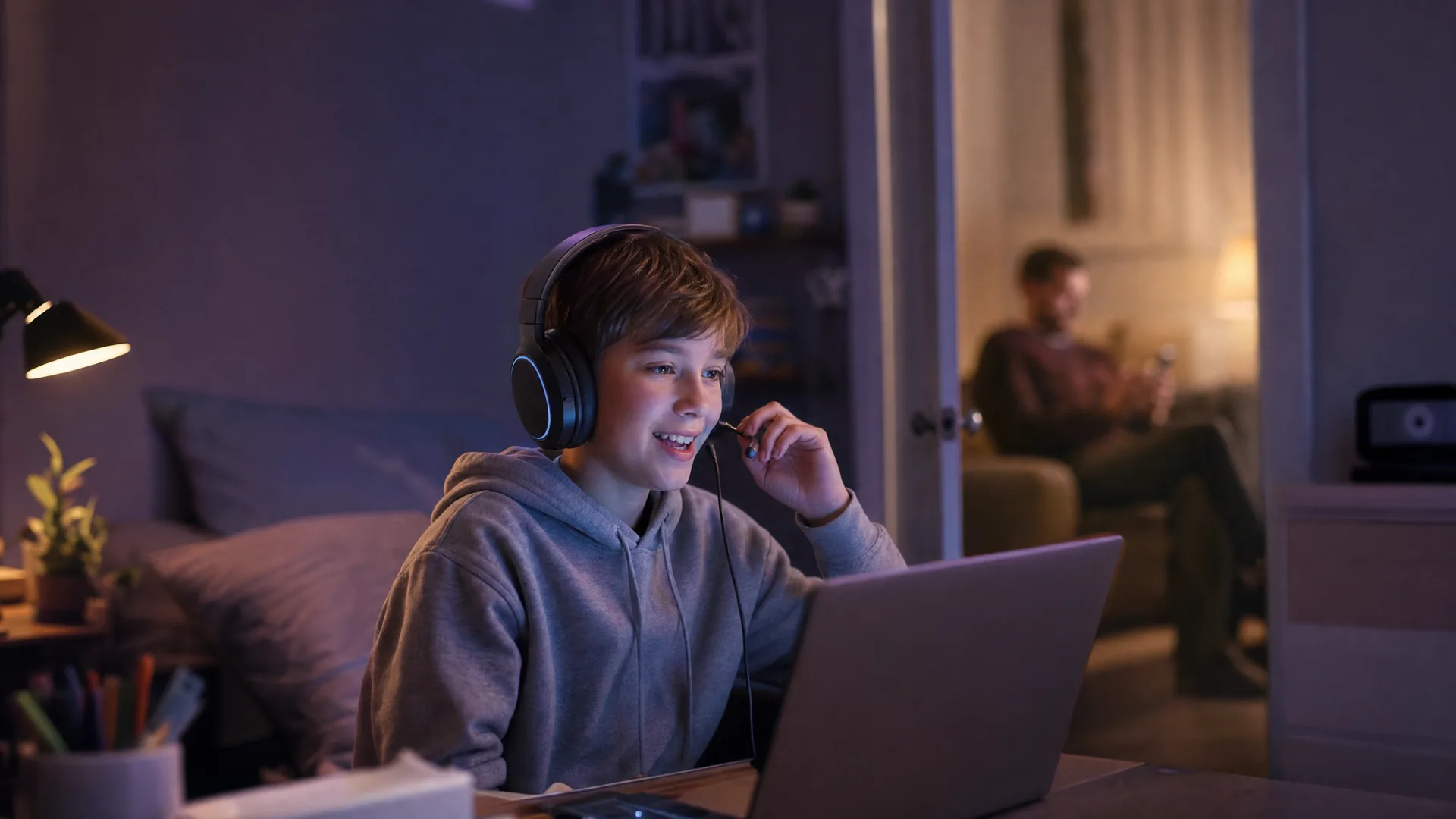
You set up Bark or Aura. You feel a little better. The dashboard says "no alerts today." Your child is in their room, headset on, playing Roblox with friends from school. Or "friends." You cannot tell which.
Here is the part nobody wants to say out loud: the most common parental control apps on the market do an excellent job of one thing, and a near-zero job of another. They read text. They scan images. They watch what your child types. They cannot hear voice chat.
That is not a complaint about those tools. They built what they built. The problem is that grooming has moved. Predators are not waiting around in text channels where Bark is reading every message. They are doing what predators always do, which is going where the adults are not looking. In 2026, that means voice.
This article walks through what text-only monitoring sees, what voice carries, why the channel difference matters, and what an honest action plan looks like for parents who already pay for a monitoring tool and want to know whether they are covered.
What text monitoring sees, and what it cannot hear
Text monitoring is a remarkable category of software. It hooks into a child's accounts (or the child's device, depending on the tool), reads the text content of messages, applies machine-learning classifiers trained on grooming language, bullying patterns, self-harm signals, and explicit content, and surfaces a daily or weekly report to the parent. Bark covers thirty-plus platforms. Aura covers texts and a handful of social apps. Qustodio mixes screen time with limited social monitoring. Boomerang focuses on Android. Apple Screen Time and Google Family Link cover usage limits but not message content.
These tools share a category, and they share a limit. The category is "text and image content scanning." The limit is that voice chat is not text and not images. It is audio that exists for two to thirty seconds at a time and then disappears. There is no log file on the device. There is no message thread on a server that the parental control app can subscribe to. Nothing is saved unless someone records it, and the platforms do not record routine voice traffic by default.
So a parent who has bought a text monitor has a powerful tool for one channel and zero tools for another. The dashboard says "no alerts today" because the dashboard cannot hear anything. That is not the same as "your child is safe today." It is more like "today, we checked the rooms with cameras."
Three platforms your child uses every week probably enable voice by default or behind a single toggle: Roblox (Spatial Voice, available to verified 13+ users), Fortnite (voice on by default in party chat across all platforms), and Discord (voice channels and voice DMs to any user the child can DM). That is most of the gaming voice surface in one breath, and none of it goes through any text monitor that exists today.
Why grooming moves to voice fast
When researchers analyzed grooming conversations on gaming platforms for the WeProtect Global Alliance's 2023 Global Threat Assessment, they found a chat with a child could escalate into high-risk grooming in as little as nineteen seconds, with an average of about 45 minutes. That analysis looked at text chat. The reason is simple. Text logs exist. You can analyze what you can read.
Voice removes the typing latency. Predators do not have to wait for a child to peck out a reply on a phone keyboard. They can talk. They can ask questions and get immediate answers. They can read emotion in a voice in a way that text strips away. If eighteen minutes is the floor for text grooming, the floor for voice is reasonably assumed to be lower, though to our knowledge no published study has measured it directly.
There is a second reason voice is the predator's preferred medium. Text is evidence. Voice is not. A predator who texts a child has produced a record. If the child shows their parent, if a screenshot gets taken, if a moderator searches the channel, the words are there. A voice conversation, once the call ends, is gone. The platform did not record it. Nothing on the child's device saved it. Nothing on the predator's device saved it. There is no exhibit A.
This is why investigators say in their public materials that gaming is "the contact vector," not the abuse vector. The FBI's Internet Crime Complaint Center has published guidance for years stating that predators use online gaming platforms to make first contact, and then move children to channels designed to be harder to trace. Voice is one of those channels. Encrypted messaging is another. Both have one thing in common: they are not visible to the standard text-and-image monitor on the parent's dashboard.
The grooming pipeline parents do not see
The typical pipeline that emerges from court records, FBI advisories, and academic analyses looks something like this.
Step one. Public text in a multiplayer game lobby. The predator says something normal. "GG. You're good at this." Friendly. Casual. No red flags.
Step two. A friend request. The predator and the child are now linked inside the platform. The next round of conversation is in a smaller group. Maybe a party of four. Still text, still inside the game.
Step three. Voice chat. The predator turns on a microphone, asks the child if they have one. The child does. They start playing together with voice on. The conversation has now moved off the text channel.
Step four. Discord, sometimes the same evening. The predator says, "I'm not always on Roblox, but I'm on Discord. Add me there?" The child does. Discord supports voice DMs. The two of them can now talk one-on-one whenever they both have the app open, and nobody else is in the room.
Step five. An off-platform call. WhatsApp. Snapchat audio messages. A regular phone number. By this point, the child believes they have a friend.
Thorn's 2022 Online Grooming Report found that 65 percent of minors had been invited by an online-only contact to move from a public chat into a private conversation on a different platform. WeProtect Global Alliance documents the same pattern across its research: perpetrators divert conversations to private messaging or end-to-end encrypted environments because the risk of detection is lower.
Text monitoring catches step one if the child types anything overtly explicit. It often misses step two through five entirely. The grooming has now happened in channels the tools cannot see.
What the data actually says
Verified numbers, every one with a primary source from the last five years.
1 in 3 (33%) of boys aged 9–12 reported an online sexual interaction in 2024. This is from Thorn's Youth Perspectives on Online Safety study, the highest rate Thorn has measured in five years of running the survey. (Thorn 2024)
3 in 4 young people aged 10–17 experience harassment in online multiplayer games. From the ADL's Hate is No Game 2023 report. The same report found 83 million of the 110 million US online multiplayer gamers experienced hate or harassment in the prior six months. (ADL 2023)
As little as 19 seconds for a conversation with a child on a gaming platform to escalate into high-risk grooming. The average is about 45 minutes. The analysis looked at chat logs. Voice is faster. (WeProtect Global Alliance 2023)
65% of minors invited to move from a public chat to a private conversation on a different platform. Thorn's 2022 Online Grooming Report. This is the move-off-platform pattern, quantified. (Thorn 2022)
302 million children, 1 in 8 worldwide, have been victims of online sexual exploitation and abuse in the past year. From the Childlight Into the Light Index 2024, published by the University of Edinburgh. (University of Edinburgh / Childlight 2024)
456,000+ online enticement reports to NCMEC's CyberTipline in 2024. Total CyberTipline reports for the year passed 20.5 million. (NCMEC CyberTipline data)
None of these stats are about voice specifically. There is no widely cited "X% of grooming happens over voice" number, partly because the channel is so hard to study. That is the point. The same property that makes voice the predator's preferred medium (no logs, no transcripts, no screenshots) also makes it nearly invisible to researchers. The numbers above describe the scale of the problem. The channel where most of it now happens is the one nobody is watching.
What voice grooming actually sounds like
This is not a section to be sensationalized. Parents do not need a frightening movie scene. They need pattern recognition.
Voice grooming is friendly. It sounds like a slightly older child, sometimes a peer, who is unusually attentive. It asks questions that text grooming asks too, but it asks them faster and more naturally, because voice is faster and more natural.
Patterns to watch for, based on transcripts in court records and the published behavioral research:
Asking about home. Who else is there. When is dad home. Where is mom right now. What time do you go to bed. Phrased as friendly curiosity.
Praising maturity. "You're really smart for your age." "You don't talk like a little child." "You're not like other children in your year." This makes the child feel chosen.
Building a secret world. "Don't tell your mom about this game." "She wouldn't get it." "Let's keep this between us." Secrecy is the single most reliable grooming flag in voice or text.
Moving the conversation. "Get on Discord, my mic doesn't work here." "Add me on Snap." "What's your phone number, I'll call you on WhatsApp." This is step three to four in the pipeline above.
Sexual normalization, then escalation. Casual mentions of sex, jokes, then questions, then requests. In voice, this can move from casual to direct in a single session.
If a child has had three voice sessions with the same outside contact in a week and the parent has never heard of them, it is worth checking in. Not interrogating. Asking who they have been playing with, what game, whether they have voice chat on, and casually whether the friend ever asks them to keep things between just the two of them. The "secret" question is the one that flags the pattern earliest.
The parental control tool gap, fairly compared
Halo did not write this article because the other tools are bad. They are not. The category needs to grow up, and the easiest way to see why is to lay out what each tool actually does.
Tool | Texts on phone | Social platforms | Web browsing | Screen time | App permissions | In-game text | In-game voice |
|---|---|---|---|---|---|---|---|
Bark | ✅ | ✅ (30+) | ✅ | ✅ | partial | partial | ❌ |
Aura Family | ✅ | ✅ (limited) | ✅ | ✅ | ✅ | ❌ | ❌ |
Qustodio | partial | partial | ✅ | ✅ | ✅ | ❌ | ❌ |
Boomerang | ✅ (Android) | ✅ (limited) | ✅ | ✅ | ✅ | ❌ | ❌ |
Apple Screen Time | ❌ (limits only) | ❌ | ❌ (limits only) | ✅ | ✅ | ❌ | ❌ |
Google Family Link | ❌ (limits only) | ❌ | ✅ | ✅ | ✅ | ❌ | ❌ |
Voice-chat monitor | varies | varies | varies | varies | varies | varies | ✅ |
Three observations. First, every tool above covers something useful. None of them are scams or weak products. Second, no general parental control tool monitors in-game voice chat content. Third, the right answer for many families is not to swap tools; it is to add the missing channel.
This is the part where it would be easy to write a pitch. The honest version is shorter: most parents who already pay for Bark or Aura should keep paying. They should also notice that the channel where grooming actually happens is the one their current tool was never built to cover.
An age-banded action plan for tonight
You do not have to buy anything to do these. They are tonight's homework regardless of which monitoring tools you use.
Ages 8–10. Voice chat off by default in every game. Roblox: Account Settings → Privacy → "Who can chat with me in app?" → Friends only. Voice chat unavailable unless you've verified your child is 13+ anyway, so this is mostly settled. Fortnite: Audio settings → Voice Chat → Off. Minecraft (Bedrock): Profile → Settings → Multiplayer Game off, or accept it on with friends-only. Talk to the child about why. "We are not stopping you playing. We are stopping strangers from being able to talk to you in your ear."
Ages 11–12. Voice chat on only with a named friends list. Sit down with the child and decide together which real-life friends are on the approved list. Add new ones together. Make it explicit that this is the rule for everyone, not a punishment. Watch one session a week, casually, in the same room, so you know what their conversations sound like. This is the age where the move-to-Discord step tends to happen. Check whether they have it, who they have added, and whether they understand that voice DMs are not group calls.
Ages 13–14. Voice chat allowed with conversation. Run the "anyone ever ask you to keep something secret?" check once a month. Make sure they know you will not take the game away if they tell you about a weird interaction. The worst thing a parent can do at this age is make the consequence of reporting harsher than the consequence of staying quiet. Check Discord friends list together once a quarter; not as a search, as a normal admin task.
All ages. Make sure the child knows the difference between "muted" and "mic off" in their games. Most children assume the mic is off when the speaker is muted; it is not. Test it once together so they know.
Gaming safety done right, private by design
This is where Halo Safe enters the article, and the point of mentioning it is to describe a design philosophy, not to sell.
Halo runs on the child's device. On the Mac or Windows machine, Discord and other VoIP voice is processed on-device; on iOS the covered surface is voice and on-screen text chat in any game. Halo monitors that voice and text. It sends you an alert when it detects grooming, bullying, or threats, not everyday chat or swearing. When it does, a redacted summary reaches the parent. Their voice never leaves their device. Only the words are analysed, then discarded. Never stored. You get a summary, not a recording. Text chat is handled the same way.
The choice that matters here is the choice not to send raw audio to a cloud server. Most parents, when they imagine "voice monitoring," imagine a black box in someone else's data center with recordings of their child's voice in it. That is not the design Halo built. It is also not the only design a voice monitor could have. There are cloud-based voice tools, and they make different tradeoffs. The honest version is that on-device processing is more private and somewhat less powerful at the bleeding edge of model size, and cloud processing is the reverse. Most families want the privacy tradeoff. Halo picked that side.
The reason this design works at all is that on-device transcription crossed a quality threshold in 2024. Models small enough to run on a phone became accurate enough to catch the language patterns that matter. Five years ago this was a research paper. Today it is a product category.
A voice monitor does not replace a text monitor. Bark is excellent at what Bark does. Aura is excellent at what Aura does. The point of adding a voice-chat tool is not to swap; it is to cover the channel that the others were not built for. For most families with children who game in headsets, the right setup is text monitoring for everything textual, plus a gaming safety tool like Halo for the game itself, which sends you an alert when it detects grooming, bullying, or threats, plus a real conversation with the child about why both are running.
FAQ
Can any parental control app monitor voice chat?
A small number of tools do, Halo among them. Halo Safe runs on iPhone, iPad, Mac and Windows. It sends you an alert when it detects grooming, bullying, or threats in your child's game. Not general chat or swearing. On iOS it covers voice and on-screen text chat in any game; on Mac and Windows it covers Discord and other VoIP voice on that computer. General parental control apps (Bark, Aura, Qustodio, Boomerang, Apple Screen Time, Google Family Link) do not transcribe or analyze voice chat content. They monitor text, web, social, and usage time. The product categories are different.
Does Bark monitor voice chat?
No. Bark's product covers text messages, email, twenty-plus social apps, web browsing, and screen time. It does not transcribe or scan the audio of voice chat sessions in games or in Discord voice channels. Bark is excellent at the text and image side. Voice is a separate channel that needs a separate tool.
Why is voice chat the most dangerous channel for grooming?
Three reasons. Voice is faster than text, removing the typing latency that gave parents and platforms time to notice. Voice leaves no log, removing the evidence trail that text grooming creates. Voice is the medium predators move conversations into when public-platform text moderation might catch them. Thorn 2022 found 65% of minors are invited to move to a different platform during grooming, and voice channels (Roblox voice, Discord voice DMs, off-platform calls) are among the destinations.
How fast can grooming actually escalate?
Analysis for the WeProtect Global Alliance's 2023 Global Threat Assessment found conversations with children on gaming platforms can escalate into high-risk grooming in as little as 19 seconds, with an average of about 45 minutes. Voice removes typing latency, so it can move at least that fast. Some predators take days or weeks. Others move from "GG nice match" to a request for personal information inside a single gaming session.
What apps have the highest grooming risk through voice?
Any platform where a stranger can voice-chat with a child. The most common in 2026: Roblox (Spatial Voice for verified 13+ accounts), Fortnite (built-in voice across all platforms), Minecraft Bedrock (voice in many third-party server clients), Discord (voice channels in any server the child has joined and voice DMs to any friend), and parties on Xbox Live or PlayStation Network where parental controls have not restricted voice. The relative risk depends on who the child is talking to, not on the brand. The pattern is consistent: predators go where parents are not listening.
Should I just turn voice chat off?
For ages 8–10, generally yes. For 11–12, off by default and on selectively with named friends. For 13–14, on with conversation. Hard bans for older tweens and teens push the activity to channels the parent cannot see, and predators love children whose parents do not know they game. Talking honestly about voice with a 13-year-old protects them more than blocking it.
The two-minute version
Text monitoring is real protection for the text channel. It is not protection for voice chat, because voice does not produce the data that text monitors are built to scan. Grooming has moved to voice for predictable reasons: voice is faster, voice does not leave a log, and the major parental control tools cannot hear it.
The fix is not to ditch the text monitor. The fix is to notice the gap and cover it. Tonight, that means checking voice chat settings in each of your child's games, having one short conversation about who they play with, and deciding what level of voice access is right for their age. Beyond tonight, it means adding a voice-aware tool to your stack, regardless of which voice-aware tool you pick.
The hardest thing to accept is that the dashboard saying "no alerts" can be true and irrelevant at the same time. A camera in the kitchen does not see what happens upstairs. The first step, before any product, is naming the room with no camera.