Quick answer: Sextortion is when someone threatens to share a nude or sexual image of a person unless they pay money or send more. With teens it is usually financial, targets boys most, and moves within hours. The response is simple: do not pay, do not delete anything, preserve evidence, and report it to the right authority for your country: NCMEC and the FBI in the United States, the ACCCE in Australia, CEOP in the United Kingdom.
If your teenager games online, chats on Discord, or has Instagram or Snapchat, they can be reached by a sextortionist in minutes. This is not a fringe threat. It is one of the fastest-growing online crimes against children, and it targets ordinary, careful children who made one mistake in a private moment.
This guide is written to be used, not to scare you. It covers what sextortion is, how it works, how fast it moves, the warning signs, and exactly what to do if it happens, step by step. It ends with short scripts you can use tonight, before anything goes wrong. The single most protective thing you can do is have this conversation early, so your teen knows they can come to you.
If it is happening right now: do this first
If your teen has just told you they are being threatened, or you have found the messages, stay calm and work through the steps below in order. Panic is what the offender is counting on.
Before anything else: if your child is in immediate danger, or is talking about suicide, get help now. These lines are free, confidential, and answer 24 hours a day.
United States: call or text 988 (988 Suicide & Crisis Lifeline). In an emergency, call 911.
Australia: Lifeline 13 11 14, or Kids Helpline 1800 55 1800 for ages 5 to 25. In an emergency, call 000.
United Kingdom: Samaritans 116 123. In an emergency, call 999.
Then, in order:
Do not pay. Paying almost never stops the demands and usually invites more. Stop immediately if any payment has already started.
Do not delete anything. Not the account, not the messages, not the app. Deleted evidence cannot help investigators identify the offender.
Preserve evidence. Screenshot the offender's profile, username, the conversation, and the demands. Note the platform and any payment app they asked for.
Stop communicating and block. After you have screenshots, block the account. Do not negotiate or plead.
Report. Use your country's route: NCMEC's CyberTipline and the FBI in the United States, the ACCCE in Australia, CEOP in the United Kingdom (details below). Then use NCMEC's Take It Down tool.
Support your teen. Say clearly: this is not your fault, you are not in trouble, and we will get through this together. If they are in distress, use one of the crisis lines above; they answer at any hour.
That is the whole emergency playbook. The rest of this guide explains why each step matters and how to prevent it in the first place.
What sextortion actually is
Sextortion is a form of blackmail. Someone obtains a sexual or nude image of a person, then threatens to share it unless the victim gives them something: money, more images, or another demand. When the target is a minor, it is a serious crime under federal law, and the child is a victim, never a participant in wrongdoing.

There are two broad patterns. In the older pattern, an offender wants more sexual images and uses one image as leverage to coerce a child into producing more. This still happens, and it disproportionately affects girls and LGBTQ+ teens.
The pattern exploding right now is financial sextortion. The offender does not want more images. They want money, fast. They pose as an attractive peer, often a girl of similar age, coax the teen into sending one nude image, and then, within minutes, drop the friendly act and start demanding payment. The threat is specific and terrifying to a 15-year-old: "Send $500 or I send this to everyone you know." This is the version most likely to reach a teen boy who games and chats online.
How it works, step by step
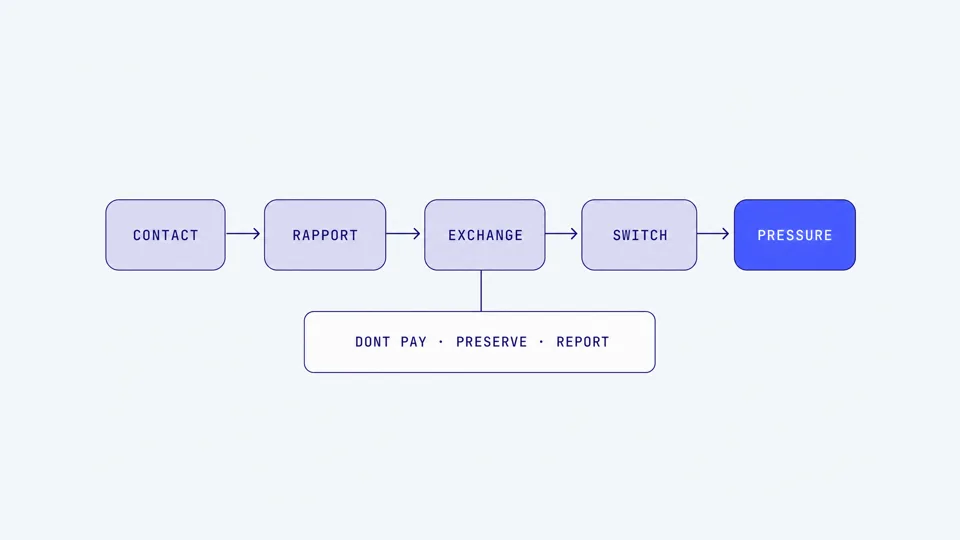
Financial sextortion follows a script. Offenders run it hundreds of times, which is exactly why recognizing the pattern breaks its power.
1. Contact. The offender reaches out on a platform where teens are, often through a fake account posing as a girl the teen's age. First contact frequently happens on Instagram, Snapchat, Discord, or inside a game's chat, then moves to a more private app.
2. Fast rapport. They flatter, flirt, and build a sense of a real connection quickly. The goal is to lower the teen's guard within a single conversation, not over weeks.
3. The exchange. They send a nude image first (usually stolen), then ask the teen to reciprocate. This reciprocity is the trap.
4. The switch. The moment they have an image, the tone flips. They reveal they have the teen's contacts, followers, or family, and demand money via gift cards, payment apps, or cryptocurrency.
5. The pressure. They flood the teen with threats, countdowns, and screenshots of their friends list. Thorn's research describes the escalation as extremely rapid, often unfolding within hours of first contact and designed to force payment before the teen can process it or ask for help.
The real numbers, and why it targets boys
The scale here is significant, and it has grown fast. In 2025, NCMEC received an average of 137 reports of financial sextortion per day, a 37% increase in daily reports over the year before. In Thorn's analysis of 2020-2023 CyberTipline data, NCMEC received roughly 812 sextortion reports a week overall, and more than two-thirds involved financial demands (NCMEC; Thorn).
The victim profile is stark. About 90% of financial sextortion victims are male, most aged 14 to 17, though the FBI has interviewed victims as young as 10 (Thorn; FBI). Offenders deliberately target boys because the shame and panic of a leaked nude tends to produce fast, silent compliance. Roughly 47% of reports show ties to offenders operating out of Nigeria and Cote d'Ivoire, which is part of why this behaves like organized financial crime rather than isolated predators (Thorn, Trends in Financial Sextortion).
The human toll is the reason to act calmly and immediately. NCMEC is aware of at least three dozen teenage boys in the United States who have died by suicide after being sextorted, and Thorn found that 1 in 7 young people who experienced sextortion as a minor harmed themselves in response (NCMEC; Thorn). If your child is struggling, the crisis lines under Where to get help are free and answer at any hour. Thorn's 2025 survey also found that 1 in 5 teens reported experiencing some form of sextortion. None of this is your teen's fault, and knowing the numbers helps you respond as a crime, not a scandal.
Warning signs a parent can notice
Teens hide sextortion because they are ashamed and afraid. You will rarely be told directly, so watch for changes in the hours and days after contact, which is when the pressure is most intense.
Sudden panic around their phone. Flinching at notifications, guarding the screen, or refusing to put the phone down.
A rapid mood crash. Withdrawal, fear, or agitation that appears within a single evening rather than building slowly.
Money worries. Asking for money, gift cards, or access to payment apps, or unexplained charges and empty accounts.
Deleting or locking down accounts. Wiping social media, going dark, or abandoning a game they loved.
A new online "friend" they will not discuss. Especially someone they met recently who moved the conversation to a private app fast.
The overlap with grooming is real. Many of the same early moves, flattery, secrecy, and a push to a private channel, appear in both. Our guide to grooming warning signs in gaming covers those patterns in depth and is worth reading alongside this one. If the person your teen met recently is the concern, learning how to tell whether your child's Discord "friend" is actually an adult walks through the tells.
Exactly what to do, in detail
Do not pay
This is the hardest instruction to follow and the most important. The FBI is explicit: do not pay, and if you have already paid, stop. Payment rarely ends the threats. Offenders often escalate after a payment because it proves the victim can be pressured. Reporting, not paying, is the fastest route out.
Do not delete, preserve evidence
Before you block anyone, capture everything. Screenshot the offender's username and profile, the full conversation, the demands, and any payment details or handles. Save these somewhere safe. Deleting the app or the messages feels protective but destroys the trail investigators need. Once you have evidence, blocking the account is fine.
Report it: United States, Australia, United Kingdom
Reporting is free and confidential in every country below, and it is the fastest route out. Use your own country's route first.
United States. File a report with NCMEC's CyberTipline at report.cybertip.org, or call 1-800-843-5678 (1-800-THE-LOST). Report to the FBI at tips.fbi.gov, through your local FBI field office, or on 1-800-CALL-FBI (1-800-225-5324). A trained analyst reviews CyberTipline reports and routes them to the right agency.
Australia. If the victim is under 18, this is the route: the Australian Centre to Counter Child Exploitation (ACCCE), led by the Australian Federal Police, takes reports at accce.gov.au/report, covering grooming, sexual coercion and blackmail. Call 000 if a child is in immediate danger, or Crime Stoppers on 1800 333 000 for a confidential report. To get the images themselves taken down, also make an image-based abuse report to the eSafety Commissioner, who can issue removal notices requiring platforms to take the material down within 24 hours.
United Kingdom. If the victim is under 18, report to the CEOP Safety Centre, part of the National Crime Agency, where reports are handled by NCA Child Protection Advisors. If the victim is 18 or over, report to the police on 101, or 999 in an emergency, and report the account to the platform as well.
Use Take It Down, and StopNCII for adults
NCMEC's free Take It Down tool (takeitdown.ncmec.org) helps stop the spread of a nude image of someone under 18. It works by creating a digital fingerprint (a hash) of the image on your own device. The image itself never leaves the device and no one views it. Participating platforms, including Instagram, Facebook, and others, use that hash to detect and remove matching content. It is not a magic internet-wide eraser and only covers participating sites, but it is a genuine, no-cost layer.
The test for Take It Down is how old the person was when the image was taken, so someone who is 18 now can still use it for an image made when they were a minor. If the image was taken at 18 or over, StopNCII.org does the same job for adults worldwide: it creates the fingerprint on your own device and shares only that with participating platforms. You need to still have the image to use it. In the United Kingdom there is also Report Remove, run by Childline and the Internet Watch Foundation, for under-18s who want an image removed without giving their real name.
Get real support, avoid paid "fixers"
The FBI has warned about for-profit companies that charge victims large fees to "help" with sextortion. You do not need them. Law enforcement and NCMEC assist for free. For your child's emotional state, the crisis lines under Where to get help are free and answer at any hour. If your child is in immediate danger, call your emergency number: 911 in the United States, 000 in Australia, 999 in the United Kingdom.
How this connects to gaming and voice chat
Sextortion of gamers usually begins with contact, and contact often begins in the places children socialize while they play. That can be a friendly voice in a game lobby, a Discord server, or a follow on Instagram that came from a shared game. The offender then steers the conversation somewhere more private.
This is why voice matters and why text-only monitoring misses so much. A lot of the trust-building that precedes an image request happens out loud, in party chat and lobbies, where no screenshot exists to review later. We wrote about that blind spot in why text monitoring misses voice grooming, and it applies directly here: the coercive conversation can be entirely spoken until the moment it moves to a phone. For the broader picture of how to keep voice chat safe across platforms, start with our voice chat safety guide.
Where Halo fits, honestly
Halo is a gaming safety app. It sends you an alert when it detects grooming, bullying, or threats, including coercion, in gaming voice or text chat. Not general chat or swearing. On iOS it covers voice and on-screen text chat in any game through a manual session you start, and on Mac and Windows it can pick up Discord and other VoIP voice running on that computer. Their voice never leaves their device. Only the words are analysed, then discarded. Never stored. You get a summary, not a recording. Text chat is handled the same way. It costs about US$8 a month billed annually (US$99.99 a year, or AU$149.99), or US$12.99 month-to-month, with a 7-day free trial. There is no Android version yet.
What you want to catch | Where it happens | Does Halo help? |
|---|---|---|
Grooming or coercion in game voice chat | Any game (iOS), Discord and other VoIP voice (Mac/PC) | Yes, an alert (any game on iPhone and iPad; Discord and other voice apps on Mac and PC) |
The switch to money demands | Usually private DMs on Instagram, Snapchat, text | No, Halo does not read social or text apps |
Nude image request itself | Private chat, often off-platform | No, this typically happens outside the game |
Console voice chat | Xbox, PlayStation party chat | No, Halo does not cover console voice |
The honest limit is this: financial sextortion frequently completes inside text and social apps that Halo does not cover. Halo is an early-warning layer for the in-game stage where contact and grooming often start, not a full shield around every app. The reporting steps above, and an open line with your teen, remain the core defense. If you want detection that helps you notice a concerning conversation in the game early, Halo can be part of the setup, alongside the conversation you are about to have.
What to say to your teen, before anything happens
The goal of these scripts is not a lecture. It is to make one message land: no matter what happens, they can come to you and they will not be in trouble. That single belief is what breaks the sextortionist's grip, because their entire leverage is the teen's fear of exposure and punishment.
Opening the conversation
"There is a scam going around that targets people your age, mostly guys. I want you to know about it so it can't work on you."
"Someone online pretends to be a girl your age, gets a nude photo, then instantly demands money and threatens to send it to everyone. It moves really fast."
Removing the shame in advance
"If this ever happens to you, even if you sent something, you are not in trouble with me. It is a crime being done to you, not by you."
"The person is bluffing on the scariest part. Paying makes it worse. The way out is telling me and reporting them, and we do that together."
Making the exit obvious
"If someone you just met online asks to move to Snapchat or Discord and gets flirty fast, that is the pattern. You can stop replying and show me."
"Come to me at any hour, no questions about what you were doing first. We solve the problem, then we talk."
Where to get help
Everything listed here is free, and the crisis lines answer 24 hours a day. If you are somewhere else, your national police non-emergency line and the platform's own reporting tool are the right first steps.
United States
Crisis support. 988 Suicide & Crisis Lifeline: call or text 988, or chat online at 988lifeline.org. Free, confidential, 24/7.
Report it. NCMEC CyberTipline: report.cybertip.org or 1-800-843-5678. FBI: tips.fbi.gov, your local field office, or 1-800-CALL-FBI.
Get images removed. Take It Down for images taken when the person was under 18, and StopNCII.org for images taken at 18 or over.
Australia
Crisis support. Lifeline: call 13 11 14 at any hour. Text 0477 13 11 14 and online chat are also available. Kids Helpline: 1800 55 1800, free and confidential for ages 5 to 25, 24/7, by phone, WebChat or email.
Report it. ACCCE: accce.gov.au/report. Call 000 if a child is in immediate danger, or Crime Stoppers on 1800 333 000 for a confidential report.
Get images removed. The eSafety Commissioner's image-based abuse report can require platforms to take material down within 24 hours. StopNCII.org works worldwide for adults 18 and over.
United Kingdom
Crisis support. Samaritans: call 116 123, free, 24 hours a day, 365 days a year, in the UK and Republic of Ireland.
Report it. Under 18: the CEOP Safety Centre, part of the National Crime Agency. 18 or over: the police on 101, or 999 in an emergency.
Get images removed. Report Remove, from Childline and the Internet Watch Foundation, for under-18s. StopNCII.org for adults 18 and over. To report child sexual abuse imagery you have seen online, the IWF takes anonymous reports.
Frequently asked questions
What is sextortion?
Sextortion is when someone threatens to share a sexual or nude image of a person unless the victim pays money or sends more images. With teens, it is usually financial: an offender poses as a peer, gets one image, then immediately demands payment and threatens to send it to the teen's friends and family. It is a crime, and the victim is never at fault.
How fast does sextortion move?
Very fast. Once an offender has an image, the threats often begin within hours of first contact and are designed to panic the teen into paying before they can think or ask for help. This speed is deliberate. It is also why teens hide it, and why calmly telling your child in advance that they can always come to you matters so much.
Who does sextortion target most?
Financial sextortion overwhelmingly targets teenage boys. In NCMEC's data, about 90% of financial sextortion victims are male, mostly aged 14 to 17, though the FBI has interviewed victims as young as 10. Offenders often pose as attractive girls of a similar age on social and gaming platforms. Girls and LGBTQ+ teens are also targeted, more often for further images.
Should my teen pay the sextortionist?
No. Paying rarely stops the demands and often leads to more. The FBI advises victims not to pay, to stop paying if they already started, and to report instead. Also avoid for-profit companies that charge large fees to "remove" images. Law enforcement and NCMEC help for free. Reassure your teen that reporting is the fastest way out.
How do I report sextortion?
In the United States, report to NCMEC's CyberTipline at report.cybertip.org or 1-800-843-5678, and to the FBI at tips.fbi.gov or 1-800-CALL-FBI. In Australia, report to the ACCCE at accce.gov.au/report. In the United Kingdom, report to the CEOP Safety Centre. Use NCMEC's free Take It Down tool to help stop the spread of images. Preserve evidence first: screenshot the account, messages, and demands, and do not delete anything before reporting.
How do I report sextortion in Australia?
If your child is under 18, report to the Australian Centre to Counter Child Exploitation (ACCCE), led by the Australian Federal Police, at accce.gov.au/report. Call 000 if they are in immediate danger, or Crime Stoppers on 1800 333 000 for a confidential report. To get intimate images removed, also make an image-based abuse report to the eSafety Commissioner, who can require platforms to take the material down within 24 hours.
What if my child is in crisis or talking about suicide?
Get support straight away and stay with them. In the United States, call or text 988. In Australia, Lifeline is 13 11 14 and Kids Helpline is 1800 55 1800 for ages 5 to 25. In the United Kingdom, Samaritans is 116 123. All are free and answer 24 hours a day. If they are in immediate danger, call 911, 000 or 999.
Can Halo detect sextortion?
Halo sends you an alert when it detects grooming, bullying, or threats, including coercion, in gaming voice or text chat, where contact often begins. Their voice never leaves their device. Only the words are analysed, then discarded. Never stored. You get a summary, not a recording. It covers voice and the game's on-screen text chat, not Instagram, Snapchat, or private text threads, where financial sextortion frequently moves once an offender has a teen's attention. Treat Halo as one early-warning layer alongside conversation and the reporting steps in this guide.
Sources
[Thorn] "Trends in Financial Sextortion: An investigation of sextortion reports in NCMEC CyberTipline data." thorn.org
[Thorn] "The state of sextortion in 2025" and "Sexual Extortion & Young People" (June 2025). thorn.org
[NCMEC] "NCMEC Releases New Data: 2024 in Numbers" and CyberTipline data. missingkids.org
[FBI] "Financially Motivated Sextortion" and "Sextortion" safety pages. fbi.gov
[FBI / DOJ] "FBI and Partners Issue National Public Safety Alert on Sextortion Schemes." justice.gov
[NCMEC] "Take It Down." takeitdown.ncmec.org
[FBI / IC3] "For-Profit Companies Charging Sextortion Victims for Assistance." ic3.gov
[OJJDP] "I Am a Victim of Sextortion, It Is Not Your Fault." ojjdp.ojp.gov
[NCMEC] CyberTipline reporting portal. report.cybertip.org
[988 Lifeline] 988 Suicide & Crisis Lifeline, call or text 988. 988lifeline.org
[Lifeline Australia] Crisis support, 13 11 14. lifeline.org.au
[Kids Helpline] Free, private counselling for ages 5 to 25, 1800 55 1800. kidshelpline.com.au
[Samaritans] Free listening service, 116 123, UK and Republic of Ireland. samaritans.org
[ACCCE] Report online child sexual exploitation. accce.gov.au/report
[eSafety Commissioner] Report image-based abuse. esafety.gov.au
[CEOP / National Crime Agency] CEOP Safety Centre and NCA sextortion guidance. ceop.police.uk; nationalcrimeagency.gov.uk
[Childline & IWF] "Report Remove." childline.org.uk; iwf.org.uk
[StopNCII] Hash-based image blocking for adults 18 and over. stopncii.org
This guide is for information and support, not legal advice. If your child is in immediate danger, call your emergency number: 911 in the United States, 000 in Australia, 999 in the United Kingdom. For crisis and reporting lines by country, see Where to get help above. Last reviewed July 2026.