Quick answer: When an online-only "friend" pushes your child to move the conversation to a private app like Discord, Snap, or DMs, treat it as one of the most predictive grooming red flags there is. It strips away the game's moderation and isolates your child. Thorn found roughly 2 in 3 minors have been asked to do exactly this. Stay calm, look at the chat together, and block the contact.
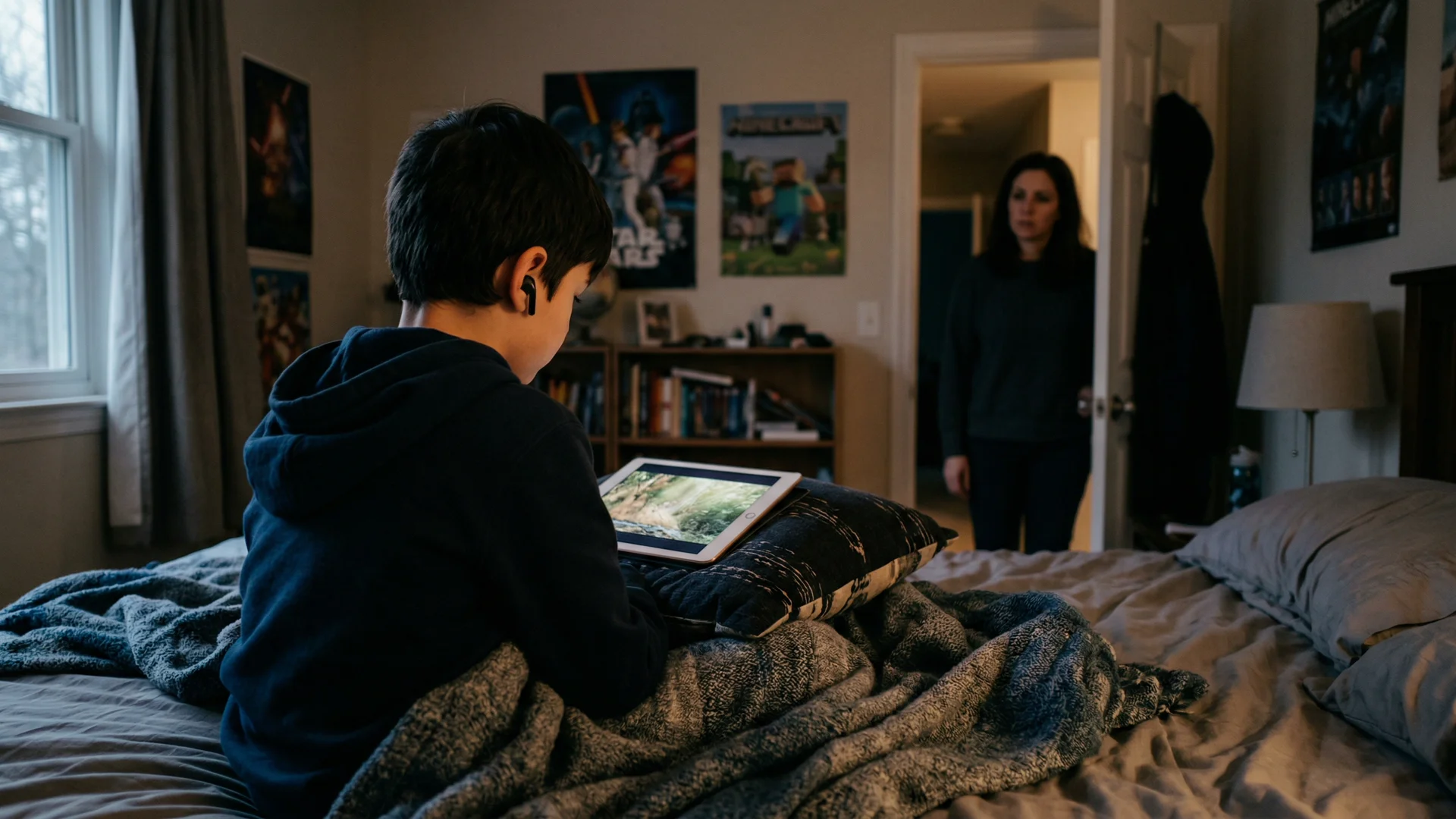
Most online-safety advice hands parents a long list of things to watch for. This post is about one signal that outweighs almost all of them. If a person your child has never met in real life wants to leave the game and talk somewhere more private, that is the moment to pay attention.
It sounds small. It is not. Researchers and child-safety organizations consistently point to this move as a hinge point where a casual gaming contact turns into something dangerous. Here is why it happens, why children do not read it as a threat, and exactly what to do.
Key takeaways
Roughly 2 in 3 minors have been asked by an online-only contact to move from a public chat into a private conversation on a different platform (Thorn, 2022).
The move exists to escape moderation and isolate the child. Games filter and report; private apps and DMs mostly do not.
Children rarely read it as danger because it feels like a normal friendship step, and the person has usually spent time building trust first.
The common pipeline is game to Discord to Snap or DMs, with each hop reducing oversight.
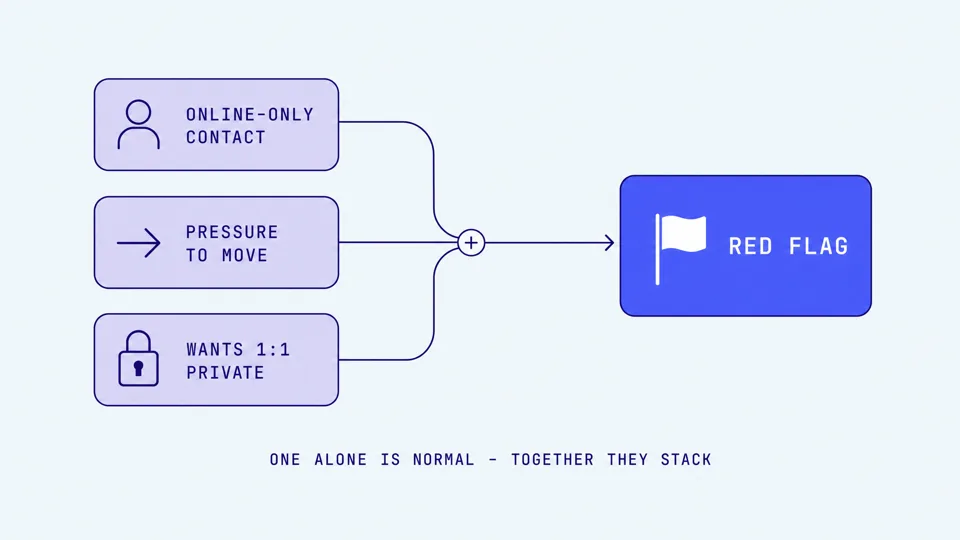
The red flag is the combination: an online-only contact plus pressure to move plus a preference for one-to-one privacy.
Why moving apps is the signal that matters
Grooming is not usually a single dramatic event. It is a sequence, and moving the conversation to a private space is the step that unlocks the rest of it. On a game like Roblox, Fortnite, or Minecraft, there is chat filtering, some level of moderation, and a report button. The moment a conversation moves to a one-to-one DM on another app, most of that protection disappears.
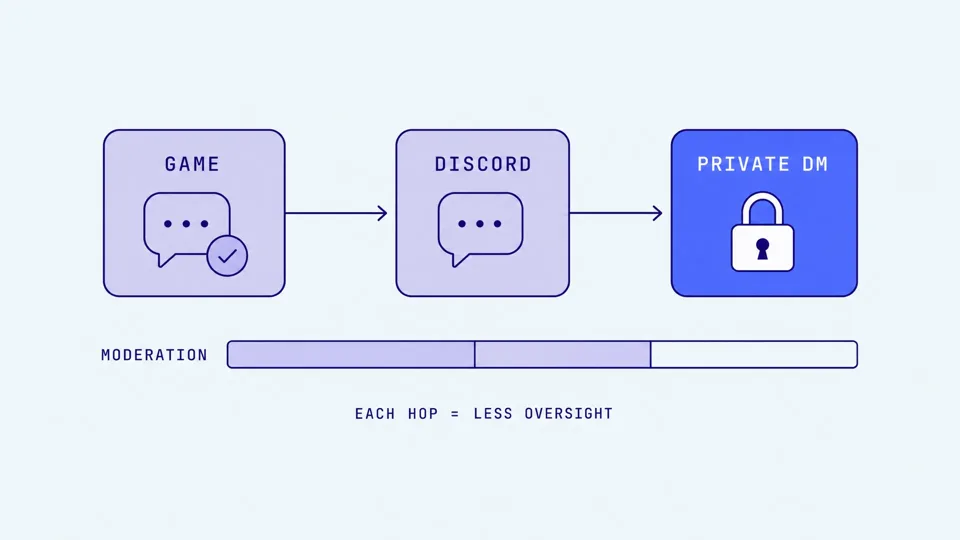
Thorn's research puts hard numbers on how routine this has become. Nearly 2 in 3 (65%) minors reported having experienced an online-only contact inviting them "to move from a public chat into a private conversation on a different platform" (Thorn, Online Grooming, 2022). Thorn is direct about why: groomers move victims to another platform to increase their own security and the victim's isolation.
The Arkansas attorney general made the same mechanic the center of a 2026 lawsuit against Roblox and Discord, describing a two-stage pipeline: initial contact on the game, then a move to a private, less-monitored space where the child is alone with the adult. That structure is not an accident. It is the tactic. The scale is climbing too: NCMEC logged more than 546,000 online enticement reports in 2024, roughly a 192% increase over 2023.
Why children do not see it as a red flag
To an adult, "let's talk somewhere private" sets off alarms. To a child, it usually does not, and there are good reasons for that.
First, the request rarely comes cold. By the time someone suggests moving apps, they have often spent hours or days being kind, helpful, and validating. They may have helped with a level, sent an in-game gift, or simply listened. The child already thinks of them as a friend, so moving to Discord feels like what friends do.
Second, platform-hopping is genuinely normal in gaming culture. Real friends move to Discord for voice, or swap Snap handles. There is nothing inherently sinister about the apps themselves, which is exactly what makes the request so easy to miss.
Third, children increasingly do not view adult contact online as unusual. Thorn found that 1 in 4 children aged 9 to 12 see it as normal for children their age to date adults aged 18 to 20, and that flirting with adults met online is widely viewed as ordinary. When the baseline is that skewed, a request to move somewhere private does not register as a warning. And because these requests are often spoken aloud, our guide on why text monitoring misses voice grooming explains why the most telling moments never leave a text trail.
The game to Discord to DM pipeline
The path from a public game to a private, less-monitored conversation follows a predictable shape. Recognizing it is more useful than memorizing a checklist.
Contact on the game. An adult joins a popular child-friendly experience and starts a casual, friendly conversation in text or voice chat.
Trust building. They help, compliment, and validate. "You're really good at this." A few gifts or Robux create a quiet sense of obligation.
The move. "Add me on Discord, it's easier to talk there." Discord feels like a natural extension of gaming, so this rarely triggers suspicion.
Deeper isolation. From Discord, the conversation often migrates again, to Snapchat, WhatsApp, or Instagram DMs, where messages can disappear and no community can see them.
Escalation. Personal questions, requests for images, secrecy ("don't tell your parents"), and pressure. By this point the child is alone with the adult and far from any report button. For teens, this is often where sextortion begins.
Voice accelerates all of this. A spoken "let's hop on Discord" during a game is casual, leaves no text trail, and is invisible to most monitoring tools. That is one reason this signal is so easy for parents to miss entirely.
What to do right now
You do not need to become a forensic investigator. A few plain steps cover most situations.
Ask who their online friends are. Not as an interrogation. "Who do you play with? Do you know them from school, or just from the game?" The online-only ones are the ones that matter here.
Make "moving apps" a talking point. Tell your child, before anything happens, that if a friend they only know online wants to move somewhere private, that is worth mentioning to you.
If it has already happened, look together. Sit down and read the conversation calmly. Note secrecy, gifts, personal questions, or any request for images.
Block and report. Report the account on both the game and the app it moved to. If there is any sexual content, an image, or a threat, preserve it and report it to the right authority for your country: NCMEC's CyberTipline in the United States, the ACCCE (accce.gov.au/report) in Australia, or CEOP in the United Kingdom. If a child is in immediate danger, call your local emergency number.
Never punish the disclosure. If your child tells you, the most important outcome is that they tell you again next time.
For the platform side of this, our guide to Discord parental controls walks through the exact settings that reduce who can DM your child, and our grooming warning signs in gaming post covers the full pattern this request sits inside.
What to say to your child
Short, calm, and framed as a pattern rather than an accusation. Pick the lines that fit your child's age.
Ages 8 to 11
"If someone you only know from a game wants to talk on a different app, come tell me first. You won't be in trouble."
"Why do you think a new friend would want to leave the game to talk somewhere private?"
"Real friends are happy to talk where we can all see. If someone wants it secret, that's a reason to check with me."
Ages 12 to 14
"When someone you met online pushes to move to Discord or Snap fast, that's actually one of the biggest red flags there is. Not the app. The push."
"Has anyone you don't know in real life ever sent you gifts or Robux, then asked to talk privately?"
"You can say 'I only add people I know in real life.' If they get weird about that, that tells you something."
Ages 15+
"The whole grooming playbook is: be nice, build trust, then get you somewhere private and alone. Knowing the move is half the defense."
"If a conversation moves to DMs and then suddenly gets personal or sexual, that's a pattern, not a coincidence. Screenshot it and tell me."
"I'd always rather hear about something awkward from you than find out later. No judgment."
Where monitoring fits, and where it doesn't
Tools help, but only if you understand their limits. Text-monitoring apps can flag phrases like "add me on Discord" in the chats they are able to read. The problem is that a growing share of these requests are spoken aloud in voice chat, where most tools are blind. Our voice chat safety guide covers this gap in depth.
This is the gap Halo is built for. Halo runs entirely on-device on iOS, Mac, and Windows and alerts you only when it detects a genuine danger pattern in gaming voice chat — grooming, bullying, or self-harm cues, including attempts to move a conversation off-platform — not general chat or swearing. The audio is processed on the device and never uploaded or stored; only the resulting alert is sent to you. It costs about US$6 a month billed annually (US$69.99/year, AU$99.99), or US$12.99 month-to-month, with a 7-day free trial. On iOS it covers in-game Roblox voice through a manual session; on Mac and PC it picks up Discord and other VoIP voice running on that computer. It does not cover console voice, it monitors voice only, recording nothing (and not text or DMs), and there is no Android version yet. It is one layer, not a guarantee — and we would rather tell you those limits up front than pretend they aren't there.
No app replaces the conversation. What a tool like Halo does is surface the one signal you are most likely to miss: the quiet, spoken "let's talk somewhere else" that never leaves a text trail. Everything else in this post is what turns that surfaced signal into a safe outcome.
Frequently asked questions
Why is an online friend wanting to chat on another app a red flag?
Because moving off a moderated game onto a private app like Discord, Snap, or DMs strips away the filtering, reporting, and adult oversight that game had. Predators do this deliberately to isolate a child and speak with less risk of being caught. Thorn found roughly 2 in 3 minors have been asked by an online-only contact to move to a private conversation, which makes it one of the most predictive grooming signals.
Is it always dangerous when a gaming friend suggests moving to Discord?
No. Real friends move platforms too, and Discord is normal for gaming groups. The signal is not the app itself. It is the combination of an online-only contact your child has never met in person, pressure or urgency to move, and a preference for a one-to-one private space. When those stack up, treat it as a red flag worth a calm conversation.
What apps do predators try to move kids to?
Most commonly Discord, because it feels like a natural extension of gaming. From there conversations often migrate again to Snapchat, WhatsApp, Instagram DMs, or other private messaging apps. Each hop reduces oversight. The Arkansas attorney general's 2026 lawsuit against Roblox and Discord described this as a two-stage pipeline: contact on the game, then isolation on a private app.
My child already added someone on another app. What should I do?
Stay calm and do not punish them for telling you. Sit together, look at the conversation, and note anything that involves secrecy, gifts, personal questions, or images. Block and report the account on both platforms. If there is any sexual content, an image, or a threat, preserve it and report it to the right authority for your country: NCMEC's CyberTipline in the United States, the ACCCE (accce.gov.au/report) in Australia, or CEOP in the United Kingdom. If a child is in immediate danger, call your local emergency number.
How do I talk to my kid about this without scaring them?
Frame it as a pattern, not an accusation. Say something like: "If a friend you only know online wants to talk somewhere private, that's worth telling me about, and you'll never be in trouble for it." Keep it curious rather than alarmed. The goal is that your child comes to you early, before a situation escalates.
Can monitoring apps catch this kind of request?
Text-monitoring tools can flag phrases like "add me on Discord" in chats they can see, but most cannot read in-game voice chat, where these requests are often spoken aloud. Halo runs entirely on-device and alerts you only when it detects a genuine danger pattern in gaming voice chat — grooming, bullying, or self-harm cues, including attempts to move off-platform — not general chat or swearing; the audio is processed on the device and never uploaded or stored, and only the resulting alert is sent to you. No tool replaces the conversation, but it can surface what you would otherwise miss.
Sources
[Thorn] "Online Grooming: Examining risky encounters amid everyday digital socialization." 2022. thorn.org (65% of minors asked to move to a private conversation; normalized adult contact among 9 to 12 year olds).
[Thorn] "New Thorn Research Examines Youth Experiences and Attitudes about Online Grooming." thorn.org.
[Thorn] "1 in 3 young boys are targeted online: What the new 2024 Youth Perspectives data tells us." thorn.org.
[NCMEC] "2024 in Numbers" and CyberTipline data (more than 546,000 online enticement reports in 2024, a 192% increase over 2023). missingkids.org / ncmec.org.
[Office of the Arkansas Attorney General] Lawsuit against Roblox and Discord describing a two-stage predatory pipeline. June 2026.
[Discord Safety] "Teen and Child Safety Policy Explainer." discord.com/safety.
[Hilliard Law] "How Predators Exploit In-Game Chat, Discord and External Apps." February 2026.
This guide is updated as platforms and research change. Last reviewed July 2026.