Quick answer: You cannot reliably tell someone's age from their voice, so don't try. Adults can sound young. Watch behavior instead: dodging video, pushing to move to a private app, sending gifts or money, love-bombing, and secrecy. One of those can be innocent. Several together is the pattern to act on.
Most parents ask the wrong question. It isn't "does this person sound like a child?" It's "does this person behave like a friend, or like someone working my child?" The voice is the least reliable signal you have. The behavior is where the truth lives.
This guide covers the real tells that a Discord "friend" is an adult, why voice chat makes age nearly impossible to prove, and what to do next. It's grounded in the documented patterns that Thorn, NCMEC, and the NSPCC see over and over. For the wider picture across every platform, start with our voice chat safety guide.
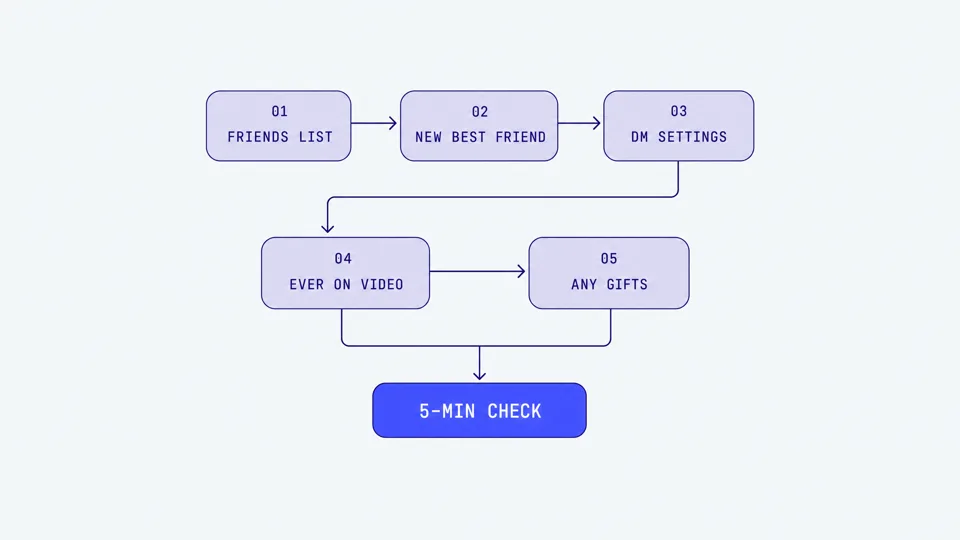
Do this first: a 5-minute Discord check
Open the friends list together. Sit with your child and go through it. For each name ask, "Where do you know them from? School? A game?" Names your child can't place are the ones to talk about.
Look for one "best friend" you've never heard of. Groomers often become the child's closest confidant fast. A brand-new, intensely close friend is worth a gentle question.
Check who can DM and friend them. In User Settings, restrict direct messages and friend requests so strangers can't slide in. Our Discord parental controls guide walks through every setting.
Ask about video and group calls. "Have you ever seen this person on camera?" A friend who has been talking for weeks but has never once shown their face is a flag.
Ask the money question. "Has anyone given you Nitro, gift cards, or game stuff?" Gifts from someone your child hasn't met in real life are one of the clearest tells.
None of these is proof on its own. You're looking for a cluster, not a single hit.
Why you can't tell age from a voice
People assume they'll "just know" an adult when they hear one. They won't. An adult who wants to pass as a teen will pitch their voice up, keep sentences short and casual, drop in current slang, and reference the same games and creators your child follows. Preparation beats instinct.
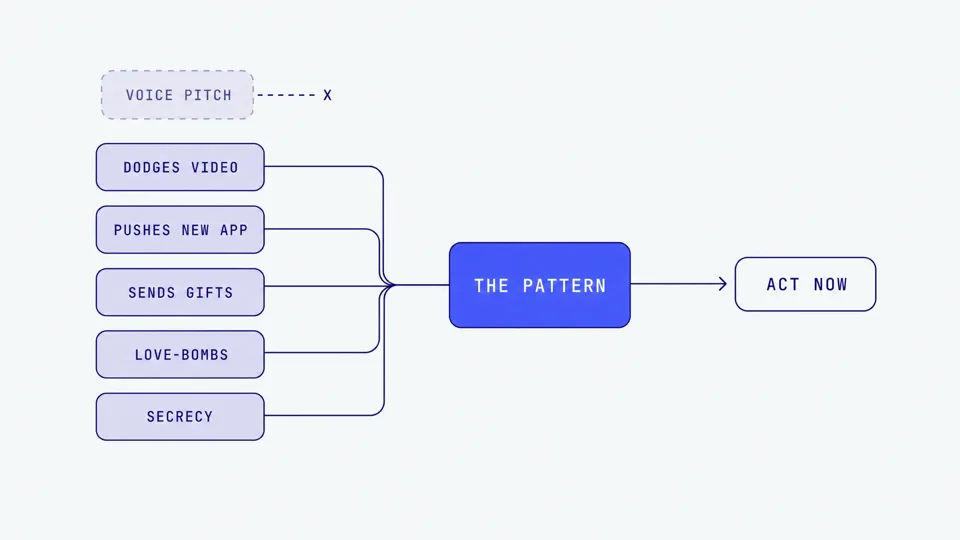
It cuts the other way too. Plenty of thirteen-year-olds sound sixteen, and plenty of grown adults have naturally high, youthful voices. If you make a decision based on how someone sounds, you'll clear real threats and panic over harmless ones in roughly equal measure.
Voice chat also leaves nothing behind. Discord voice isn't recorded by default, so there's no transcript to scroll back through the way you can with texts. Live, private, and unlogged is exactly the environment manipulation prefers. That's a big reason grooming so often happens on voice and then moves somewhere even more private. Our piece on why text monitoring misses voice grooming gets into the mechanics.
The behavior tells that actually matter
These are the signals investigators and child-safety researchers see repeatedly. Read them as a set. The danger is in the combination and the direction of travel over time.
They dodge video and live group calls
An adult pretending to be a peer will find endless reasons to never appear on camera. "My webcam's broken." "I look terrible today." "Let's just voice chat." A genuine same-age friend usually has no problem hopping on video or joining a group call with your child's other friends, because there's nothing to hide. Persistent, creative avoidance of any face-to-face contact is one of the strongest tells there is.
They push to move off Discord
This is the single most reliable warning sign, and the research backs it up. In Thorn's youth research, most young people who had an online-only contact said that person asked, at some point, to move the conversation from a public space into a private one on a different app. The move is the point: a smaller, more private, often encrypted space where moderation is weaker and a parent is less likely to look.
Watch for "let's talk on Snap / Telegram / WhatsApp / iMessage instead." Ask your child directly whether any Discord friend has suggested moving the conversation somewhere else. If yes, slow everything down.
They send gifts, Nitro, or money
Gifts create a quiet sense of debt and secrecy. Discord Nitro, gift cards, game currency, or straight cash all do the same job: they make the child feel special, indebted, and reluctant to walk away. NCMEC and Thorn both flag unsolicited gifts from online-only contacts as a core grooming move, and it often runs alongside flattery. A "friend" who spends money on your child but has never met them deserves scrutiny.
They love-bomb early
Intense flattery and fast intimacy, well beyond what a new friendship warrants, is love-bombing. "You're so mature." "You're the only one who gets me." "I've never connected with anyone like this." It's designed to make the child feel understood and to build dependence quickly. When emotional closeness outpaces how long they've actually known each other, take note.
They insist on secrecy
"Don't tell your parents." "This is just between us." "People wouldn't understand." Secrecy is load-bearing for a groomer, because isolation is what makes everything else work. Any adult building a private, hidden relationship with a child is behaving in a way a safe adult never would. If your child hesitates to talk about a specific friend, that hesitation is information.
Small tells that stack up
Reference mismatch: they mention adult things a same-age peer wouldn't, like work, driving, alcohol, or being nostalgic about things from before your child was born, then cover quickly.
Schedule mismatch: they're consistently online during school hours or late on weeknights, on an adult's rhythm rather than a child's.
Personal questions early: pushing for full name, school, town, or "just checking, how old are you exactly?" in the first few conversations.
Steering toward sexual topics: jokes that test boundaries, then "just kidding," then pushing a little further. Escalation can be fast. Researchers who study offender chat logs have found grooming can turn sexual within the first conversation, sometimes in well under an hour.
The numbers parents should know
This isn't a rare, distant risk. The scale is well documented.
Thorn's youth research consistently finds that a large share of minors report being approached online by someone they came to believe was trying to befriend and manipulate them, and that many say they have had an online sexual interaction with someone they believed to be an adult. In the same body of work, most young people who had an online-only contact reported being asked, at some point, to move the conversation to a more private platform. These are self-reported experiences, so the true picture is likely broader still.
Discord shows up in this landscape because of what it is, not because it is uniquely dangerous. Any platform with open voice channels and direct messages, used heavily by children, becomes a place this happens. Investigations by outlets including NBC News have documented cases where offenders used Discord to reach and exploit children, which is the practical reason it belongs on a parent's radar.
In England & Wales, police recorded 7,263 Sexual Communication with a Child offenses in the most recent reporting year, roughly double the count from when the offense first came into force in 2017/18 (NSPCC). Where the child's gender was recorded, around 8 in 10 targets were girls. The real total is certainly higher, because so much of this happens in private spaces that are hard to see into.
For the specific behavior-by-behavior patterns, our grooming warning signs in gaming guide goes deeper.
Where Discord's own safeguards help, and where they stop
Discord has tightened up. From 2026 it applies teen-by-default settings globally and uses age assurance, including on-device facial age estimation and, in some cases, ID checks, to unlock adult features. Messages from people outside a user's friends list get routed to a separate request inbox, and friend requests from strangers trigger warnings.
Those are real improvements. They are also not a guarantee. Age estimation can be fooled or misjudged, and an adult who lies convincingly can land in the wrong bucket. More importantly, the moment your child accepts someone as a friend, most of the stranger-protections fall away. The risk isn't usually the random DM. It's the accepted "friend" who has spent weeks earning trust. Verification is a floor, not a finish line.
Can you actually see what's said on Discord voice?
Discord's parental tools let you restrict who can contact your child and see their recent activity through the Family Center. What they don't do is tell you what's being said in a voice call. That's the gap most parents don't realize exists until they go looking.
Tool | What it does on Discord | Platform | Limitation |
|---|---|---|---|
Discord Family Center | Shows who your child friends and messages (not content) | All | No message or voice content. Teen must opt in. |
Bark | Text monitoring on connected accounts | iOS, Android | No voice chat. Coverage varies. |
Qustodio | Screen time and app blocking | Multi | No voice content at all. Blocking, not listening. |
Halo | Sends you an alert when it detects grooming, bullying, or threats in Discord on a Mac or Windows PC. | Mac, Windows | Desktop only for Discord (no console voice). Their voice never leaves their device. Only the words are analysed, then discarded. Never stored. From about US$8/mo billed annually (US$99.99/yr), or US$12.99 month-to-month. |
Halo runs on the computer where your child uses Discord, on Mac or Windows. It sends you an alert when it detects grooming, bullying, or threats in the chat: the exact behaviors above, secrecy, gift offers, pressure to move apps, sexualized escalation, not general chat or swearing. Their voice never leaves their device. Only the words are analysed, then discarded. Never stored. You get a summary, not a recording. To be clear about the limits: on Discord, Halo monitors the chat on that computer and records nothing, it can't verify anyone's real age, and it doesn't cover voice chat on a console, where your child talks through the Xbox, PlayStation, or Switch rather than the computer. It's one layer, not a guarantee, but it helps you notice a concerning conversation weeks earlier than you'd notice it on your own. For the wider trade-off, see on-device vs cloud monitoring.
What to say to your child
Opening the door (any age)
"You're not in trouble, and you never will be for telling me about something online. I just want to help."
"Some adults pretend to be children online. It's genuinely hard to tell. It's not your fault if someone tricks you."
The move-platform tell
"If a friend from Discord ever wants to move to Snap or another app, tell me. Real friends are fine staying where they are. Why would they need it private?"
Gifts and flattery
"Has anyone online given you Nitro, gift cards, or money? That's not a nice surprise, it usually means they want something back."
"If someone you've never met keeps telling you how special or mature you are, that's a trick grown-ups use. Come tell me."
If something already feels off
"If something happened that feels weird or embarrassing, I'd so much rather hear it from you than find out later. We'll deal with it together, no drama."
For the bigger picture on whether Discord is safe at your child's age and what to set up first, see our Discord safety guide for every age, 10 to 16.
If you think it's an adult, do this
Stay calm. A panicked reaction can push your child to hide the relationship rather than end it. Keep them talking.
Save evidence. Screenshot the profile, username, and any messages before blocking. Don't delete anything.
Don't confront the person. Tipping them off can escalate things or destroy evidence.
Block and report on Discord. Use in-app reporting for the user and the server.
Report to authorities. In the US, file with the NCMEC CyberTipline at report.cybertip.org. In the UK, use CEOP. If there's been sexual contact, threats, or an attempt to meet, contact local police.
Frequently asked questions
Can you tell someone's real age from their voice in Discord?
No, not reliably. Adults can raise their pitch, speak casually, and use current slang to sound younger, and some teens sound older than they are. Voice is a weak age signal. What matters far more is behavior over time: dodging video, secrecy, gifts, and pressure to move to a private app. Judge the pattern, not the pitch.
What are the biggest warning signs a Discord friend is an adult?
The strongest tells are behavioral: refusing to turn on video or join a group call, pushing to move to a private or encrypted app, sending money or game currency, excessive flattery early on, secrecy ("don't tell your parents"), and knowing adult references a same-age peer would not. Any one can be innocent. Several together is a pattern worth acting on.
Why is grooming so hard to catch on voice chat?
Voice chat is live and leaves no transcript, so there is nothing for a parent to scroll back through later. It also builds trust and familiarity faster than text because it feels personal. Discord voice is not saved by default, which is exactly why the manipulation happens there and then moves to a private app.
What should I do if I think my child's online friend is an adult?
Stay calm and keep your child talking rather than shutting it down, which can push things underground. Save evidence with screenshots, do not confront the person yourself, and block them. Report to Discord and, in the US, to the NCMEC CyberTipline at report.cybertip.org. If there has been sexual contact or threats, contact your local police.
Does Discord's age verification stop adults from contacting kids?
It helps but does not solve it. From 2026 Discord applies teen-by-default settings and facial age estimation, which routes messages from non-friends to a request inbox. But adults can misstate their age, and once your child accepts a friend request, most of those protections fall away. Verification is a floor, not a guarantee.
Can Halo tell me if my child is talking to an adult on Discord?
On Mac and Windows, Halo runs on the computer where your child uses Discord and sends you an alert when it detects grooming, bullying, or threats, like grooming, secrecy, gift offers, or pressure to move platforms, not general chat or swearing. Their voice never leaves their device. Only the words are analysed, then discarded. Never stored. You get a summary, not a recording. It cannot verify anyone's real age or read minds. It surfaces the concerning conversation so you can step in earlier than you otherwise would.
Sources
[Thorn] "Youth Perspectives on Online Safety" and related youth-monitoring research (share of minors approached by a manipulative online contact; online sexual interactions with someone believed to be an adult; requests to move to a private platform). thorn.org
[Thorn] "2025 Impact Report" (online grooming detection; signs of grooming surfaced in text). thorn.org/about/our-impact/2025-impact-report
[NSPCC] "Data shows how criminals are using private messaging platforms to manipulate and groom children." 2025. 7,263 Sexual Communication with a Child offenses; around 8 in 10 targets girls. nspcc.org.uk
[NSPCC] "Online grooming crimes against children increase by 89% in six years." 2024. nspcc.org.uk
[NCMEC] CyberTipline reporting guidance. report.cybertip.org
[Discord] "Discord Launches Teen-by-Default Settings Globally" and "How to Complete Age Assurance on Discord." 2026. discord.com
[Help Net Security] "Face scans and ID checks are coming to Discord." February 2026. helpnetsecurity.com
[NBC News] "Discord servers used in child abductions, crime rings, sextortion." nbcnews.com
[WeProtect Global Alliance] "Global Threat Assessment 2023." weprotect.org
This guide is updated as Discord changes its safety features. Last reviewed July 2026.