Quick answer: Call of Duty: Black Ops 7 and Warzone are rated M for Mature (17+) for intense realistic violence, blood, and strong language, so they are not built for children. For most children under 13 it is a no. The bigger risk than the violence is open voice chat with strangers, so lock down both the Activision account and your console's family settings.
Rating body | Classification | Age |
|---|---|---|
ESRB (North America) | M for Mature | 17 and up |
PEGI (Europe and UK) | PEGI 18 | 18 and up |
ACB (Australia) | MA15+ | Restricted to 15 and up |
These ratings apply to Call of Duty: Black Ops 7 (November 2025) and Warzone. The ESRB content descriptors include Blood and Gore, Intense Violence, Strong Language, Suggestive Themes, and Use of Drugs. The ratings cover the game's content. They do not cover what strangers say in voice or text chat, because online interactions are not rated.
Call of Duty is one of the most requested games in households with tweens and teens, and one of the hardest for parents to say no to. The current title, Call of Duty: Black Ops 7, launched in November 2025, and its free battle royale mode, Warzone, is a download away on almost any console or PC. That accessibility is exactly why the age rating and the voice chat deserve a proper look.
If you set up Screen Time or console time limits and figured that covered it, those tools cap how long your child plays. They do nothing about who talks to them in a squad or what gets said. This guide gives you the honest age-by-age call, the real risks with numbers, and the exact settings to change.
Do this first: the 5-minute Call of Duty safety checklist
Sign in to your child's Activision account at my.activision.com and open Account > Privacy & Parental Controls.
Set voice chat and text chat to Off or friends-only.
Set friend requests to friends-only or block requests from strangers.
Open your console or PC family settings (Xbox, PlayStation, or Windows) and restrict who can communicate with your child. This is a separate layer from Activision.
Confirm the account birthday is correct. An underage account triggers parental consent, which locks chat by default.
That gets the basics in place. The rest of this guide explains why each layer matters and where the gaps are.
What age rating is Call of Duty, and why
Call of Duty: Black Ops 7 is rated M for Mature (17+) by the ESRB, PEGI 18 in Europe and the UK, and MA15+ by the Australian Classification Board. The ESRB content descriptors include Blood and Gore, Intense Violence, Strong Language, Suggestive Themes, and Use of Drugs. It is the latest mainline entry in the series, and nearly every mainline Call of Duty carries the same ratings. MA15+ is a legally restricted category in Australia: retailers cannot sell the game to anyone under 15 without a parent present.
The "M" is not a formality. The gameplay is photorealistic military combat with visible blood, and the campaign includes graphic, sometimes disturbing scenes. Warzone, the free-to-play battle royale, contains the same violence and the same unfiltered communication with strangers. Because Warzone is free, it slips past the purchase gate that would otherwise make a parent pause.
The one exception is Call of Duty: Mobile, which is rated T for Teen. It is a lighter, separate product. If your younger child is set on Call of Duty, Mobile is the officially milder entry point, though it still has online multiplayer and chat you will want to review.
What the M rating really means for the violence
The ESRB assigns M when content is generally suitable for ages 17 and up. For Call of Duty specifically that means sustained realistic gun violence, blood effects, and story moments that can be intense for younger players. Whether your individual child can handle that is a judgment only you can make, and it is worth actually watching a few minutes of gameplay before deciding.
The risk parents miss: open voice chat with strangers
Here is the part most age-rating guides underplay. The violence is visible and you can judge it. The voice chat is invisible, and it is where the real safety exposure lives.
In standard multiplayer and Warzone, your child can be dropped into a lobby or squad with strangers of any age, and voice chat is on by default in many modes. Activision does run AI voice moderation, called ToxMod, and by its own reporting it acted on around two million accounts for voice violations in one recent title, and cut exposure to toxicity by roughly 25 percent in that game. That is real, and it helps. But moderation catches toxicity after the fact. It does not stop an adult from starting a friendly conversation with your child, and parents cannot see or review any of it.
Voice creates trust faster than text. It feels personal, it is harder to walk away from mid-game, and it leaves no record you can check later. For a curious 11 or 12-year-old, a stranger who is nice, helps them win, and suggests moving the chat to Discord or Snapchat is a familiar grooming pattern, not a rare one.
The numbers parents should know
Thorn's 2024 Youth Perspectives research found that 1 in 3 boys aged 9 to 12 reported having an online sexual interaction, the highest rate in five years, with the biggest jumps in being sent sexual messages and being asked to send a nude photo. Boys are the core Call of Duty demographic.
The National Center for Missing and Exploited Children (NCMEC) received 1.4 million reports of online enticement in 2025, up 158 percent from the year before. Grooming can also move fast: the WeProtect Global Alliance's 2023 threat assessment found that gaming-platform conversations can escalate to high-risk grooming in as little as 19 seconds, with an average of about 45 minutes. None of that is unique to Call of Duty, but a game full of squad-based voice chat is exactly the kind of environment where it starts. Our guide to grooming warning signs in gaming covers the pattern in detail.
Age-by-age: is Call of Duty right for your child?
Age | Verdict |
|---|---|
10 | No. Seven years below the ESRB rating. The violence is graphic and voice chat puts them with adult strangers. |
11 | No. Still well below the rating. If friends play, try Call of Duty: Mobile (rated T) with chat off. |
12 | Not yet. Five years under the rating. If you allow supervised play, voice and text must be off at both Activision and console level. |
13 | Only with strict restrictions. Voice off, text off, friend requests locked. Have the "add me on Discord" conversation. |
14 | With restrictions and a conversation. Voice off or friends-only at both layers. They can understand the "why" if you explain it. |
15 | With settings locked. At the ACB MA15+ line, still under the ESRB M rating. Voice friends-only. Coach them on the luring pattern. |
16 | Probably yes, with settings. One year under the ESRB rating. Voice friends-only is still sensible. Keep check-ins going. |
17 | At the ESRB rating. The call shifts to whether they know how to handle voice chat with strangers. Friends-only voice is a good default. |
Every verdict above assumes you have configured both the Activision account settings and your console or platform family controls. Without both layers, the restrictions do not hold.
What you can and cannot lock down
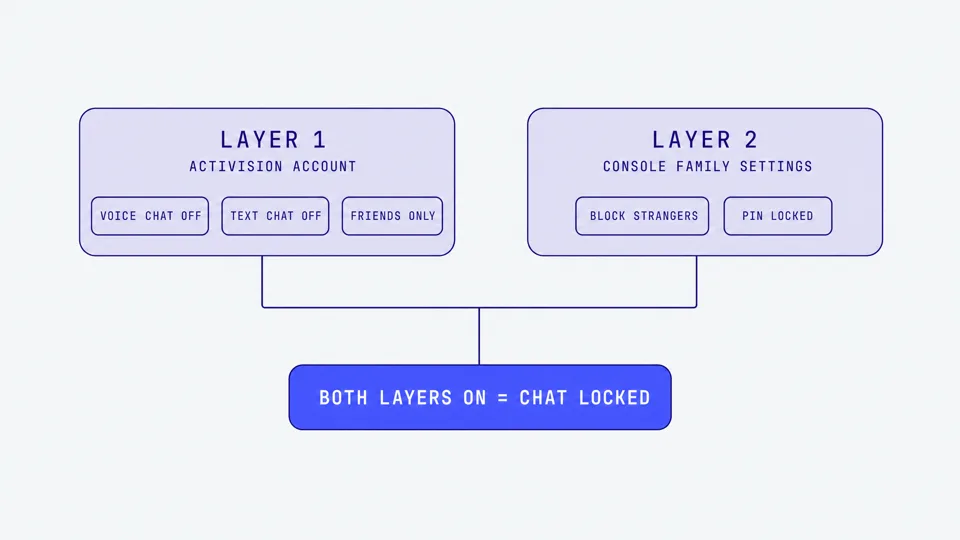
Call of Duty gives you two separate control layers, and you need both.
Layer 1: the Activision account
Sign in to your child's Activision account at my.activision.com.
Open Account > Privacy & Parental Controls.
Set voice chat to Off or friends-only.
Set text chat the same way.
Restrict friend requests so strangers cannot add your child.
Confirm the date of birth is accurate. Underage accounts trigger a parental consent flow that turns chat off until consent is granted.
Layer 2: the console or PC
The Activision settings sit on top of your platform's own family controls, and the platform layer is often the stronger lock because your child cannot change it without your PIN.
Xbox: Use the Xbox Family Settings app to block communication with strangers. Our Xbox voice chat parental controls guide walks through it.
PlayStation: Set the child account's communication restrictions in Family Management.
Windows PC: Use Microsoft Family Safety, and manage in-game voice separately.
The honest limit: console voice is a closed system
This is the part no tool can fix for you. On Xbox and PlayStation, in-game voice runs through the platform's closed audio system. That means no third-party tool, including Halo, can access or alert you to console voice chat. Your only real levers on console are Activision's settings and the platform family controls, which restrict who can talk to your child rather than showing you what was said.
On PC and Mac, Halo monitors the voice chat and the in-game text chat. It sends you an alert and a short summary with enough context to talk to your child. This is the same gap we cover in our explainer on why text monitoring misses voice grooming.
If your child moves Call of Duty conversations to Discord afterward, our Discord voice chat safety guide covers the risks in voice channels.
Where Halo fits, and where it does not
Halo monitors the voice chat and the in-game text chat in every game your child plays, on iPhone, iPad, Mac and Windows. It sends you an alert when it detects grooming, bullying, or threats, including a stranger pushing to move the chat to another app. It does not flag general chat or swearing. Only the words are analyzed, then discarded. Never stored. Only the resulting alert and a short summary reach you. There is no Android version yet, and on iPhone the session needs a manual start.
For Call of Duty specifically, be clear on what that means. If your teen plays on a Windows PC or Mac, Halo monitors the voice chat and the in-game text. It sends you an alert and a short summary when it detects grooming, bullying, or threats. If they play on an Xbox or PlayStation, Halo cannot access the console's voice chat, and neither can anything else. On iPhone and iPad, Halo covers voice and text in mobile games, but Call of Duty is primarily a console and PC title. If your child also plays other shooters, our guide to Fortnite voice chat safety walks through the same voice-chat questions for a game your younger ones are more likely to be asking for.
Where your child plays Call of Duty | Can a parent get danger alerts? | Best lever |
|---|---|---|
Xbox / PlayStation console | No (closed audio system) | Activision + console family settings (restrict, not monitor) |
Windows PC | Yes, voice and text (Halo, on device, never recorded) | Halo + Activision settings |
Mac | Yes, voice and text (Halo, on device, never recorded) | Halo + Activision settings |
Call of Duty: Mobile (iPhone, iPad) | Yes, voice and text (Halo, on device, never recorded) | Halo + in-app chat restrictions |
The honest takeaway: for console Call of Duty, no monitoring tool exists, so restriction plus conversation is your whole toolkit. On PC, Mac, iPhone and iPad, Halo monitors the voice chat and the in-game text chat. It is one layer, not a substitute for the settings above. For the full picture across platforms, see our voice chat safety guide.
What to say to your child about Call of Duty
Ages 10 to 12
"This game is made for people 17 and up, mostly because of how realistic the violence is. Let's find something that fits you better, or we play the milder mobile version with chat off."
"If we ever do play, you won't be talking to strangers. That is the rule, not a punishment."
Ages 13 to 16
"When you're in a squad with people you don't know, some of them are adults. If anyone gets too friendly, too fast, or asks to talk somewhere private, that is worth telling me about."
"Nobody normal needs to move the conversation to Discord or Snap. If they push for that, it's a flag."
"You will never be in trouble for telling me something felt off. I would rather hear it from you."
Ages 17+
"Voice chat with strangers is part of this game. If someone asks where you go to school, how old you are, or wants photos, that pattern is worth knowing about even at your age."
Frequently asked questions
What is the age rating for Call of Duty?
Call of Duty: Black Ops 7 is rated M for Mature (17+) by the ESRB in North America, PEGI 18 in Europe and the UK, and MA15+ by the Australian Classification Board. Warzone carries the same ratings. The M and PEGI 18 classifications mean the content is intended for adults, and MA15+ is a legally restricted category for ages 15 and over. Nearly every mainline Call of Duty title shares these ratings. The one exception is Call of Duty: Mobile, which is rated T for Teen.
Is Call of Duty safe for kids?
Call of Duty: Black Ops 7 and Warzone are rated M for Mature (17+) for intense realistic violence, blood, and strong language, so they are not designed for children. The bigger day-to-day risk is open voice chat with strangers. For teens close to the rating, you can make it safer by restricting voice and text chat through the Activision account and console family settings, and by talking about what to watch for.
What age rating is Call of Duty?
The current title, Call of Duty: Black Ops 7 (released November 2025), is rated M for Mature (17+) by the ESRB, PEGI 18 in Europe and the UK, and MA15+ in Australia. The ESRB descriptors include Blood and Gore, Intense Violence, Strong Language, Suggestive Themes, and Use of Drugs. Warzone carries the same ratings. Only Call of Duty: Mobile is rated T for Teen and is a milder, separate experience.
Can you monitor voice chat on Call of Duty?
It depends on the platform. Activision runs its own AI voice moderation (ToxMod) for toxicity, but parents cannot review that chat. On console (Xbox, PlayStation), no third-party tool can access the voice chat because it runs through the platform's closed audio system. On PC and Mac, Halo monitors the voice chat and the in-game text chat. It sends you an alert when it detects grooming, bullying, or threats. Only the words are analyzed, then discarded. Never stored.
How do I turn off voice chat in Call of Duty?
Log in to your child's Activision account, go to Privacy and Parental Controls, and set voice chat and text chat to Off or restricted. Also set the console-level controls: on Xbox and PlayStation family settings you can block communication with strangers entirely. Do both, because Activision settings and console settings are separate layers.
Does Call of Duty have parental controls?
Yes, at two levels. The Activision account has Privacy and Parental Controls for voice chat, text chat, and friend requests, and asks players for a birthday, which triggers parental consent for underage accounts. Separately, Xbox, PlayStation, and Windows have their own family settings that control who can communicate with your child. You should configure both.
Is Warzone safe for kids?
Warzone carries the same M (17+) content as the main game: realistic gun violence, blood, and unfiltered voice chat with strangers in squads. Because it is free to play, it is easy for children to download without a purchase gate. Treat it exactly like the paid game for age and voice-chat decisions.
Sources
[ESRB] "Call of Duty: Black Ops 7" rating summary. esrb.org
[PEGI] Call of Duty: Black Ops 7 rating. pegi.info
[ACB] Call of Duty: Black Ops 7 classification. classification.gov.au (rating confirmed via PlayStation Store AU)
[Activision] "Call of Duty Voice Chat Moderation FAQ." support.activision.com
[Activision] "Online Safety Guide" and "Parental Consent." activision.com, support.activision.com
[GamesBeat / Modulate] "How ToxMod's AI impacted toxicity in Call of Duty voice chat." Case study, ~25% reduction in exposure to toxicity in Modern Warfare III. gamesbeat.com
[TechRadar] "Call of Duty's AI-powered anti-toxicity voice recognition has already detected 2 million accounts." techradar.com
[Thorn] "1 in 3 young boys are targeted online: What the new 2024 Youth Perspectives data tells us." thorn.org
[NCMEC] CyberTipline 2025 data: 1.4 million online enticement reports, up 158%. missingkids.org
[WeProtect Global Alliance] Global Threat Assessment 2023: gaming-platform grooming can escalate in as little as 19 seconds. weprotect.org
[Bark] "How To Set Up Call Of Duty Parental Controls." bark.us
This guide is updated as Call of Duty and its platforms change their safety features. Last reviewed September 2026.