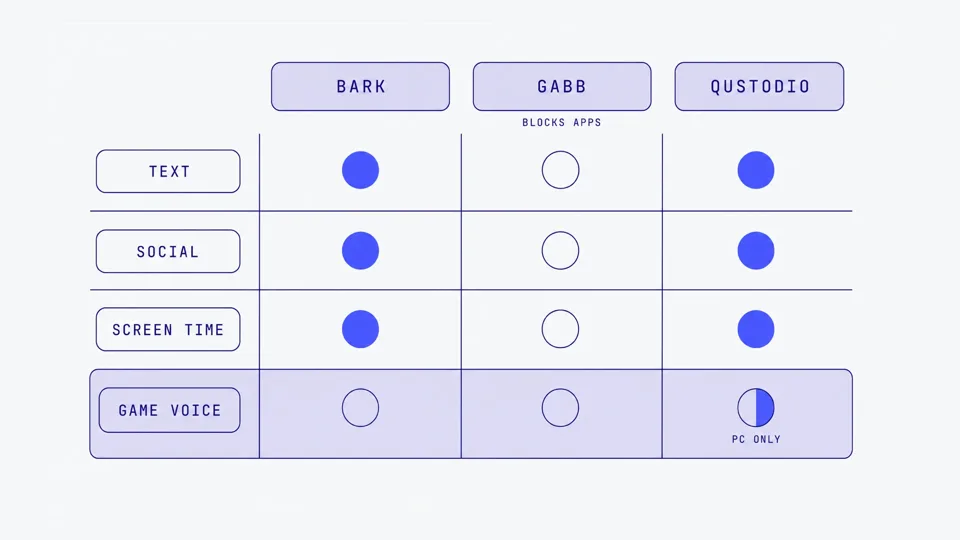
Quick answer: Bark monitors texts, email, and social apps for concerning content. Gabb sells locked-down child phones with no gaming or social apps at all. Qustodio does screen time, web filtering, and Android social monitoring. All three do useful things, but only Qustodio touches in-game voice chat, and only on Windows.
If you are trying to choose between Bark, Gabb, and Qustodio, the first thing to know is that they are not really the same kind of product. Comparing them straight across is like comparing a smoke detector, a house with no stove, and a home security camera. They overlap, but each was built to solve a different worry.
This guide breaks down what each one actually does, roughly what it costs in 2026, and where each fits. Then it gets to the part most comparison articles skip: only one of the three reaches live in-game voice chat, and only on Windows PCs. That matters if your child plays Roblox, Fortnite, or hops on Discord calls with people they met in a lobby.
How we compared: we checked vendor product, support, and pricing pages against five criteria: monitored content, supported platforms, gaming-voice coverage, price, and limits. These are documentation checks, not hands-on accuracy tests. Price examples are US-dollar figures recorded in October 2026; region, contract, and promotions can change the checkout total.
Disclosure: We make Halo, which appears in this comparison. We have tried to be straightforward about every tool's strengths and limits, including ours.
Sources checked against vendor documentation and published research, . This comparison is based on publicly available feature descriptions and pricing; it does not include independent lab testing of monitoring accuracy. Sources listed below.
The short version: who each one is for
Bark is for parents who want to keep a normal smartphone but get alerted when something concerning shows up in texts, email, or social media. It reads content and flags it. It does not block the whole internet, and it does not listen to voice chat.
Gabb is for parents who want a more restricted first device. Its phones and watches restrict access to open browsing and social platforms rather than monitoring a separate gaming device. That reduces some exposure; it does not remove every risk.
Qustodio is for parents focused on screen time, web filtering, and app limits across devices, with social monitoring on Android. It recently added a gaming-voice alert feature, but only on Windows.
If your main concern is who your child talks to and what gets said while they game, hold that thought. We will come back to it, because it is the one thing this trio handles worst.
Bark: content monitoring for texts and social
Bark is an alert system. You install it (or buy a Bark Phone that runs it built-in), and it uses AI to scan your child's messages and accounts for signs of trouble: cyberbullying, adult content, self-harm and suicidal ideation, sexual predators, threats, and more. When it spots something, it sends you an alert with context rather than showing you every message your child sends.
That "alerts, not a live feed" design is intentional and, honestly, one of Bark's better qualities. It respects a teen's privacy while still catching the dangerous stuff. Bark monitors 30+ social platforms at the account level and works across texts, email, and YouTube.
Pricing (2026): Bark Jr is about $5/month and covers screen time, location, and web filtering. Bark Premium, which adds the content monitoring, is around $14/month or roughly $99 for the year. There is also a Bark Phone (hardware) and Bark Watch if you want the monitoring baked into the device.
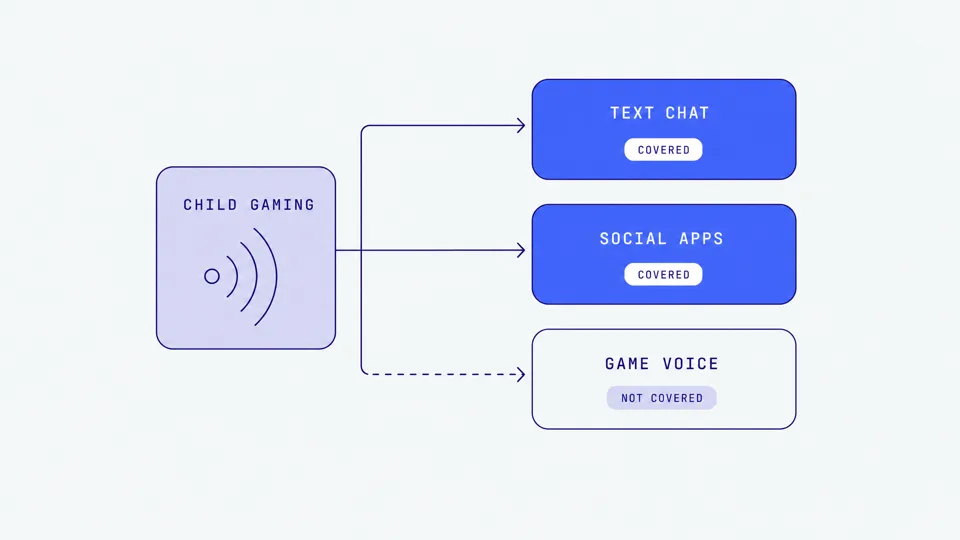
The gaming catch: Bark does not monitor in-game voice chat. It reads text and screens voice memos on iPhones, but it does not listen to a live Roblox lobby, a Fortnite party, or a Discord call. If a stranger is talking to your child through their headset, Bark is not in that conversation. We go deeper on this in our Bark voice chat monitoring breakdown, an honest look at whether Bark monitors Roblox and game voice chat.
Gabb: restrict access instead of monitoring gaming
Gabb takes the opposite approach. Instead of monitoring risky apps, it sells devices that never had them. A Gabb phone has no gaming, no social media, no app store, and no open web browser. Children can call and text within a parent-managed contact list, and that is roughly it. The Gabb Watch adds GPS, safe zones, tasks, and speech-to-text messaging for younger children.
For a first phone, a restricted device can simplify the choices. Parents still need to manage contacts and settings. A Gabb device also does not protect a separate tablet, console, or computer your child uses.
Pricing (2026): You pay for the device plus a plan. The Gabb Watch 3e retails at about $230 (around $160 refurbished), with watch plans roughly $13 to $18/month depending on contract length. Check activation charges and promotions at checkout. Gabb phones follow a similar device-plus-plan model.
The gaming catch: because Gabb blocks gaming entirely, there is no gaming chat to keep safe. That is fine if your plan is to keep your child off Roblox and Fortnite for a few more years. It does not help at all the moment they get a real phone, a tablet, or a console and start playing. Gabb delays the problem; it does not solve it for gamers.
Qustodio: screen time, web, and a new gaming-voice feature
Qustodio combines screen-time limits, web filtering, app blocking, location features, and activity reports. Coverage differs by operating system and app. Its plan page marks several social-message alerts as Android-only, while calls and messages monitoring on iOS requires a Windows or Mac computer. Check the specific feature rather than assuming Android and iPhone coverage match.
Pricing (2026): Qustodio Basic runs about $5/month billed annually (~$60/year) and covers up to five devices. Qustodio Complete is about $9/month billed annually (~$105/year) and adds unlimited devices, YouTube monitoring, and calls and messages monitoring. Gaming alerts is included in both plans.
The gaming update worth knowing: Qustodio launched a "Gaming alerts" feature that monitors in-game voice chat. It uses AI to flag aggressive or bullying language, inappropriate or adult conversation, boundary-crossing personal questions, and threats, then sends you a short summary of what was detected. It now supports Discord, Steam, Roblox, Valorant, and Fortnite (Discord was added in ).
The important limits: Gaming alerts is Windows-only right now, it requires the Qustodio Children app running on a Windows 10 or 11 PC, and the analysis happens in Qustodio's cloud. Qustodio states that audio is processed automatically and never stored or accessible to Qustodio. So it is real progress, but it does nothing for the huge number of children who game on an iPhone, iPad, or console. We cover the specifics in our Qustodio voice chat guide.
Side-by-side comparison
Here is the honest layout, including where each tool stops and where Halo fits in for in-game voice and text chat specifically.
Tool |
What it is |
Platforms |
In-game voice chat |
Rough price (2026) |
|---|---|---|---|---|
Bark |
Content-monitoring app (texts, email, 30+ social) |
iOS, Android; Bark Phone/Watch |
No. Text and voice memos only. |
~$5/mo (Jr), ~$14/mo (Premium) |
Gabb |
Locked-down child phones and watches |
Gabb hardware only |
No. Gaming is blocked entirely. |
~$230 device + ~$13-18/mo plan |
Qustodio |
Screen time, web filter, Android social, gaming alerts |
iOS, Android, Windows, Mac |
Yes, but Windows-only + cloud-processed |
~$5/mo (Basic) or ~$9/mo (Complete), annual |
Halo |
In-game voice and text chat safety (alerts for grooming, bullying, and threats only) |
iOS (any game), Mac, Windows (no Android yet) |
Yes. Their voice never leaves their device. Only the words are analysed, then discarded. Never stored. |
See the current in-app subscription offer |
Read across the "in-game voice chat" column and the pattern is clear. Two of the three big names do not touch it, and the one that does is stuck on Windows. That is the gap this article exists to name.
The blind spot parents still face: live voice chat
Text monitoring, screen limits, and restricted devices do different jobs. A feature that scans messages does not automatically analyse live voice conversations.
The WeProtect Global Alliance's 2023 Global Threat Assessment reported a minimum of 19 seconds and an average of 45 minutes for gaming conversations to escalate into high-risk grooming. That finding concerns gaming chat, not a comparison proving voice is riskier than text.
Thorn's 2024 survey found that one in three boys aged 9 to 12 reported an online sexual interaction in their lifetime. This is an online-safety finding, not a gaming-only or voice-only rate.
Text filtering alone does not analyse a conversation happening out loud. A time limit on one device also does not protect a different gaming device. We explain this distinction in why text monitoring misses voice grooming. Check voice coverage separately from message filtering.
Where Halo fits (and where it does not)
Halo is the piece this trio is missing: it is built specifically for in-game voice and text chat safety. It monitors voice and text chat inside the game for grooming, bullying, and threats, not general chatter or swearing. On iPhone and iPad, it covers any game through a manual session your child or you start. On Mac and Windows, it covers any game plus Discord and other VoIP voice on that computer. Their voice never leaves their device: speech is turned into text on the device, and only the words are analysed, then discarded, never stored.
Check the current in-app offer before subscribing. Halo can sit alongside device controls rather than replace them. Its privacy policy distinguishes local audio processing, default cloud text analysis, optional local analysis, and the safety scores and paraphrased summaries stored for parents.
Now the limits, because being straight about them is the whole point of this article. Halo does not run on Android yet. On iPhone and iPad it needs a session to be started rather than running invisibly all day, a tradeoff of how Apple handles audio. It does not reach console voice chat (Xbox and PlayStation are closed systems). It covers voice and the game's on-screen text chat only, so it never reads phone texts, DMs, or WhatsApp. And it is not a screen-time or web-filtering tool, so it is a companion to those features, not a substitute. Treat it as one layer, not a guarantee that catches everything. For the full picture on covering voice across every platform, start with our voice chat safety guide.
How to choose, by situation
You want a safe first phone for a younger child
Gabb is the cleanest answer. No gaming, no social, nothing to lock down, because it was never installed. Pair it with real conversations about online safety and you have bought yourself a couple of low-drama years. Just remember that day one on a "real" phone or a shared console resets the risk, and you will want a plan for that transition.
You want to keep a normal phone but catch red flags in messages
Bark is strong here. The alerts-not-a-feed model catches the dangerous stuff without you reading every message. Add Halo if your child also games with voice on iPhone, iPad, Mac, or PC, because Bark will not be in those calls.
You mostly care about screen time, web filtering, and app limits
Qustodio is the value pick, especially on the annual Complete plan. If your child games on Windows, its Gaming alerts feature adds real voice coverage. If they game on iOS or console, that feature will not reach them, so Halo fills the mobile gap.
Your child games a lot, especially Roblox, Fortnite, or Discord
Whatever else you pick for screen time and text, treat voice as its own layer. Qustodio (on Windows) or Halo (any game on iOS, plus Mac and Windows) are the tools that actually reach gaming voice chat, and Halo sends you an alert when it detects grooming, bullying, or threats rather than surfacing everything said. For platform-specific setup, see our guides on Roblox voice chat safety, Fortnite voice chat safety, and Discord parental controls. For why the microphone is the channel these tools miss, see what to do if you've heard an adult voice through your child's headset.
What to say to your child about voice chat
Ages 8 to 11
"When you play, do you ever talk to people you don't know in real life? What do they sound like?"
"If someone asks you to move to a different app to talk, like Discord, that is something to tell me about. You won't be in trouble."
"Grown-ups can sound like children online. If a voice ever makes you feel weird, you can just leave. You don't have to be polite."
Ages 12 and up
"Public voice lobbies mean anyone can end up talking to you, including adults. That is normal to be a bit careful about."
"If someone gets personal fast, asks where you live or what school you go to, or wants to keep it secret, that is a pattern worth knowing about."
"I am not trying to read your DMs. If a conversation makes you uncomfortable, you can leave and tell me. We can check the game's reporting options together."
Frequently asked questions
What is the difference between Bark, Gabb, and Qustodio?
They solve different problems. Bark is a content-monitoring app that scans texts, email, and 30+ social platforms for concerning messages. Gabb sells physical child-safe phones and watches that block gaming, social media, and the open internet entirely. Qustodio is a screen-time and web-filtering app with social monitoring on Android. Bark and Qustodio are software you install; Gabb is a device you buy.
Which is better for gaming safety, Bark or Qustodio?
Qustodio is ahead for gaming right now because it launched a Gaming alerts feature that flags concerning in-game voice chat on Discord, Steam, Roblox, Valorant, and Fortnite. The catch: it is Windows-only and cloud-based (though Qustodio states audio is never stored). Bark does not monitor in-game voice chat at all. Neither covers gaming voice on iPhones, iPads, or consoles, which is where a lot of children actually play.
Does Bark monitor in-game voice chat?
No. Bark monitors text messages, email, and content inside 30+ social apps, and it screens voice memos on iPhones. It does not listen to or analyze live in-game voice chat in Roblox, Fortnite, Discord calls, or any other game. If your child's risk is coming through the headset, Bark will not see it.
Is Gabb a monitoring app?
No. Gabb is a hardware company that sells locked-down phones and smartwatches for children. There is no gaming, no social media, no app store, and no open web browser on a Gabb device. It prevents risk by removing the apps entirely rather than monitoring them, so there is nothing to monitor and no gaming-voice coverage.
How much do Bark, Gabb, and Qustodio cost?
Bark Premium is around $14/month (roughly $99/year); Bark Jr is about $5/month. Gabb charges for the device (the Gabb Watch 3e retails at about $230) plus a service plan from roughly $13 to $18/month. Qustodio runs about $5/month for Basic or $9/month for Complete, billed annually. Prices shift with promotions, so check each site before buying.
What covers gaming voice chat on iPhone or iPad?
Very little does, which is the gap parents keep hitting. Bark and Gabb do not, and Qustodio's Gaming alerts feature is Windows-only. Halo monitors voice and text chat inside the game for grooming, bullying, and threats on iPhone, iPad, Mac, and Windows. On iPhone and iPad it covers any game through a manual session. On Mac and Windows it covers any game plus Discord. Their voice never leaves their device. Only the words are analysed, then discarded. Never stored.
Sources
Bark. Products and pricing.
Gabb. Gabb Watch 3e and phones and plans.
Qustodio. Premium plans; Gaming alerts; voice activity support; Discord support and audio retention.
WeProtect Global Alliance. Global Threat Assessment 2023 data.
Thorn. 2024 youth survey findings.
Source check, . This update clarifies Qustodio's Windows gaming-voice coverage and removes unsupported voice-versus-text risk comparisons. If a price or feature has changed, email hello@halosafe.app and we will correct it.
This guide is for informational purposes and reflects each vendor's published features and pricing at the time of review. No monitoring tool can guarantee a child's safety online. If you believe a child is in immediate danger, contact local law enforcement. To report suspected online exploitation, use the NCMEC CyberTipline (US), CEOP (UK), or your national reporting body.